State the measures initiated by Reserve Bank of India to regulate credit disbursed by Non-Banking Financial Institutions.
In short
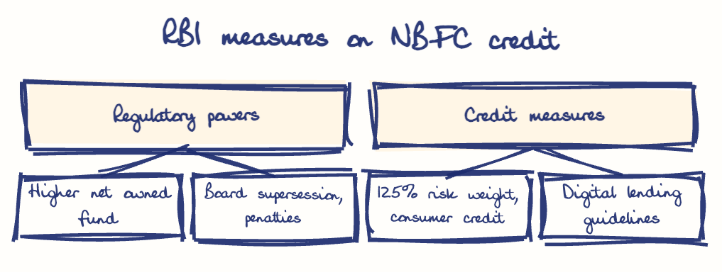
The 2019 RBI Act amendment let the RBI raise NBFCs' minimum net owned fund, supersede boards and direct resolution of stressed firms. It also added liquidity risk frameworks, raised risk weights on consumer credit to 125%, issued digital lending guidelines and required reporting to credit information companies.
Model answer
Ghissu Editorial · Verified 4 Oct 2026 · 279 words
Enhanced Supervisory Powers
The amended RBI Act lets RBI raise minimum net owned funds for NBFCs from ₹2 crore up to ₹100 crore (now ₹10 crore under scale-based regulation) and remove directors, improving governance.
Group Audits and Penalties
NBFCs must annex group financials and allow RBI inspections; RBI can impose penalties and direct resolution via amalgamation or reconstruction.
Liquidity Risk Management3
RBI’s liquidity risk frameworks for NBFCs over ₹100 crore assets improved resilience but posed compliance challenges for smaller NBFCs in Andhra Pradesh.
Risk Weight Adjustments
Raising risk weights on consumer credit to 125% curbed exuberance but affected NBFC lending dynamics.
Digital Lending Regulation
RBI’s guidelines on digital lending platforms address mis-selling and unethical recovery, important for fintech NBFCs in Andhra Pradesh.
Credit Information Transparency
Mandatory reporting to credit information companies enhances credit risk evaluation, aiding MSMEs in Andhra Pradesh.
State-Level Coordination
RBI should strengthen collaboration with Andhra Pradesh regulators to monitor local NBFC credit flows.
Capacity Building
Support for smaller NBFCs in compliance and risk management can improve stability without limiting credit.
Financial Literacy and Protection
Expanding depositor education and grievance redressal in rural and semi-urban Andhra Pradesh safeguards borrowers.
Technology for Supervision
AI and data analytics can enable RBI’s real-time NBFC credit monitoring.
This model answer is indicative and the model can make mistakes; please verify key facts independently.
Practise this question
1Get the answer sheet
Sized for this question.
2Write your answer
Timed, by hand.
3Get it marked
Your score and what to fix.
This chapter in the exam
Resource Mobilization in Indian Economy19 questions
Asked in 7 of 8 sittings since 2008
Most tested: Public debt and its sustainability in post-reform India.
- 2025Differentiate between internal and external public debt. Explain their relative advantages and risks for a developing country like India.
- 2025Discuss the key instruments of Monetary Policy (RBI) and Fiscal Policy in India and evaluate their role in resource mobilisation and inflation management.
All 19 questions, sorted by sub-topic, with model answers and practice.
Question from the official APPSC Group-I Mains 2012 paper. Answer written by Ghissu's engine and checked against our editorial standards. Found an error? Tell us and we correct it within 48 hours.