Discuss briefly various reasons leading to the loss of bio-diversity.
In short
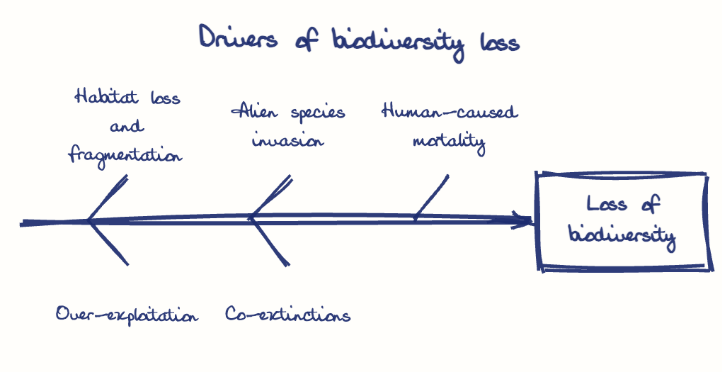
Biodiversity is lost mainly through habitat destruction and fragmentation, overexploitation of plants and animals, invasive alien species such as water hyacinth and Lantana, and co-extinctions that cascade through dependent species. In Andhra Pradesh, overfishing on the coast and forest fragmentation show how these drivers erode ecosystem services and livelihoods.
Model answer
Ghissu Editorial · Verified 4 Oct 2026 · 237 words
Habitat Fragmentation and Conflict
In Assam and Karnataka, landscape fragmentation1 causes human-elephant conflict2 and mortality hotspots, while South India’s corridor fragmentation disrupts species movement, intensifying biodiversity loss. For example, in Andhra Pradesh, forest conversion for agriculture and aquaculture fragments habitats, threatening species like the Asian elephant, whose small population in the state survives mainly in the Rayala Elephant Reserve.
Development-Induced Disruption
Large-scale projects such as the Great Nicobar Project3 cause biocultural disruption and biodiversity loss, illustrating how infrastructure development impacts ecosystems and indigenous communities. This highlights the need for environmental impact assessments and inclusive planning.
Conservation vs Displacement
Sanctuary creation in Saranda4 forest shows tensions between biodiversity protection and tribal displacement, underscoring socio-environmental dilemmas. The Mani Shankar Aiyar Committee (2012) emphasized holistic empowerment of forest communities to balance conservation with livelihoods.
Advanced Monitoring and Policy
DNA-based5 elephant census improves biodiversity assessment accuracy, enabling better conservation strategies. The committee also advocates sustainable resource use and community participation to mitigate biodiversity loss effectively.
This model answer is indicative and the model can make mistakes; please verify key facts independently.
Practise this question
1Get the answer sheet
Sized for this question.
2Write your answer
Timed, by hand.
3Get it marked
Your score and what to fix.
This chapter in the exam
Biotechnology & Nanotechnology: scope, ethics, genetic engineering, biodiversity, fermentation, immuno-diagnosis50 questions
Asked in 8 of 8 sittings since 2008
Most tested: Biodiversity and biotechnology governance/ethics, especially conservation, GMOs, and applied public-health biotech.
- 2025Trace the evolution of India's National Biotechnology Development Strategy (NBDS) and discuss its key objectives. Critically evaluate its impact on the growth of the biotechnology sector in India.
- 2025Analyze the potential of plant-derived biopharmaceuticals in promoting sustainable healthcare. Explain how the application of green pharmacy principles can help minimize environmental harm at each stage of the pharmaceutical lifecycle.
All 50 questions, sorted by sub-topic, with model answers and practice.
Question from the official APPSC Group-I Mains 2012 paper. Answer written by Ghissu's engine and checked against our editorial standards. Found an error? Tell us and we correct it within 48 hours.