Explain various causes for the changes in climate and its effect on both the living and non-living bodies on the Earth.
In short
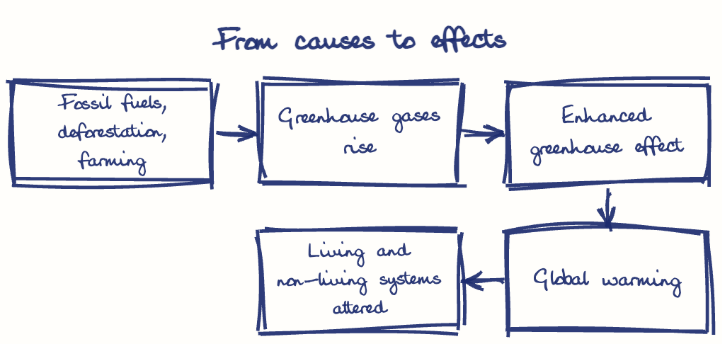
Climate change today is driven mainly by human greenhouse gas emissions from fossil fuels, deforestation and agriculture, alongside natural factors like solar cycles and volcanoes. It harms living bodies through biodiversity loss, crop stress and disease, and non-living bodies through sea-level rise, stronger cyclones, altered rivers and ocean acidification.
Model answer
Ghissu Editorial · Verified 4 Oct 2026 · 263 words
Anthropogenic Greenhouse Gas Emissions
Fossil fuel combustion, deforestation, and agriculture raise greenhouse gases; Andhra Pradesh’s aquaculture and Eastern Ghats deforestation notably increase methane and CO2 locally.
Land Use Changes and Agriculture
Deforestation in Seshachalam Hills reduces carbon sinks; livestock and chilli cultivation in Andhra Pradesh emit methane and nitrous oxide, intensifying warming.
Biodiversity Loss and Agricultural Stress
Rising temperatures disrupt habitats, threatening species like the Indian pangolin in coastal mangroves; drought in Rayalaseema causes crop failures and pest outbreaks.
Human Health and Livelihood Disruption
Heatwaves in Visakhapatnam increase heat-related illnesses; fisheries along Andhra Pradesh’s 974 km coast suffer from ocean warming and acidification.
Sea-Level Rise and Extreme Weather
Thermal expansion and glacial melt cause sea-level rise, leading to salinity ingress and land loss on Andhra Pradesh’s east coast; cyclones Hudhud and Titli exemplify increased storm intensity.
Hydrological Changes and Ocean Warming
Variability in Krishna and Godavari river flows affects irrigation; warming Bay of Bengal waters disrupt marine biodiversity and fisheries.
Forest Conservation and Carbon Sequestration
Strengthen CAMPA implementation in Andhra Pradesh to enhance forest cover and climate regulation.
Climate Resilience Measures
Promote sustainable agriculture and coastal protection to mitigate impacts on livelihoods and ecosystems.
This model answer is indicative and the model can make mistakes; please verify key facts independently.
Sources
Practise this question
1Get the answer sheet
Sized for this question.
2Write your answer
Timed, by hand.
3Get it marked
Your score and what to fix.
This chapter in the exam
Development vs Environment: natural resources, climate change, EIA, natural disasters48 questions
Asked in 8 of 8 sittings since 2008
Most tested: Climate change and mining/environmental degradation links
- 2025Explain the different types of natural resources in India. How are they being conserved through government initiatives?
- 2025Investigate the relationship between mining activities and the occurrence of earthquakes. Explain how mining operations can be regulated to minimize seismic risks.
All 48 questions, sorted by sub-topic, with model answers and practice.
Question from the official APPSC Group-I Mains 2012 paper. Answer written by Ghissu's engine and checked against our editorial standards. Found an error? Tell us and we correct it within 48 hours.