Write a short note on the recent development taking place in the most popular National Solar Mission.
In short
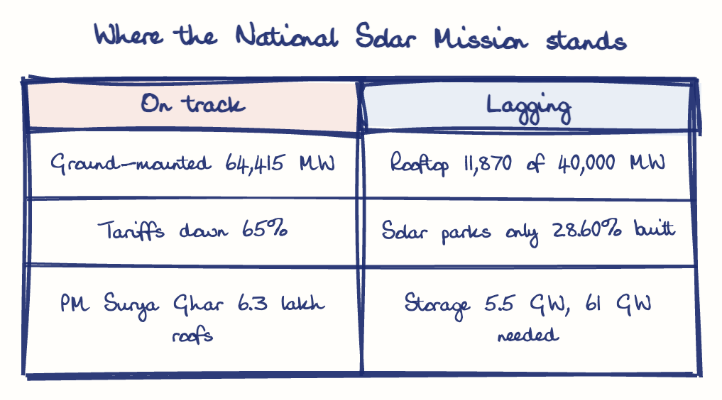
The National Solar Mission, under the National Action Plan on Climate Change, raised India's solar capacity to 94.17 GW by November 2024 and cut tariffs by 65%. Recent schemes like PM Surya Ghar and PM-KUSUM push rooftop and farm solar, though rooftop (11,870 of 40,000 MW) lags.
Model answer
Ghissu Editorial · Verified 4 Oct 2026 · 275 words
Multi-Phase Planning and State Role
The mission’s three phases (2010-22) allow adaptive targets, implemented by MNRE and states like Andhra Pradesh4, leveraging solar potential for large projects.
Manufacturing Incentives
The Production Linked Incentive (PLI) Scheme and ‘Make in India’ campaign boost domestic solar panel production, reducing import dependence.
Capacity Achievements and Gaps
Ground-mounted solar reached 64,415 MW by March 2024, but rooftop solar is only 11,870 MW against a 40,000 MW target; fund release for solar parks is just 40% of ₹8,100 crore.
Rural Electrification Impact
PM Surya Ghar installed over 6.3 lakh rooftop units in nine months for households, while PM-KUSUM serves farmers, including in Andhra Pradesh.
Cost and Market Growth
Solar tariffs dropped 65% in a decade, enhancing competitiveness and job creation, notably in Visakhapatnam’s port-led industrial corridor.
Climate and Sustainability Goals
The mission supports India’s NDC to cut emission intensity by 45% by 2030 and aids drought-prone regions like Rayalaseema in Andhra Pradesh.
Improve Fund Utilization
Strengthen mechanisms for timely fund release and project monitoring.
Expand Rooftop Solar and Storage
Promote rooftop solar via subsidies and invest in energy storage to manage intermittency.
This model answer is indicative and the model can make mistakes; please verify key facts independently.
Practise this question
1Get the answer sheet
Sized for this question.
2Write your answer
Timed, by hand.
3Get it marked
Your score and what to fix.
This chapter in the exam
Energy: needs, resources, policy; Nuclear programme and policy24 questions
Asked in 8 of 8 sittings since 2008
Most tested: Renewable energy transition in India, especially solar/clean energy and barriers to large-scale adoption.
- 2025Differentiate between conventional and non-conventional energy resources. Explain their relevance in India's energy sector.
- 2023What is the current scenario of renewable power generation in India ? Discuss the factors responsible for the growing focus and shift towards Renewable energy.
All 24 questions, sorted by sub-topic, with model answers and practice.
Question from the official APPSC Group-I Mains 2012 paper. Answer written by Ghissu's engine and checked against our editorial standards. Found an error? Tell us and we correct it within 48 hours.