Write an essay on National Literacy Mission.
In short
The National Literacy Mission, launched in 1988, aimed to give functional literacy to 80 million people aged 15-35 through a partnership of governments, voluntary agencies, universities and state resource centres, linked to post-literacy and awareness. It made gradual progress, but gender gaps and fading volunteerism required successors like Saakshar Bharat.
Model answer
Ghissu Editorial · Verified 4 Oct 2026 · 280 words
Broad Institutional Base
NLM engaged central and state governments, over 500 voluntary agencies, universities, and youth centres, fostering community participation1 and targeting marginalized groups such as Scheduled Castes and Scheduled Tribes.
Population and Gender Barriers
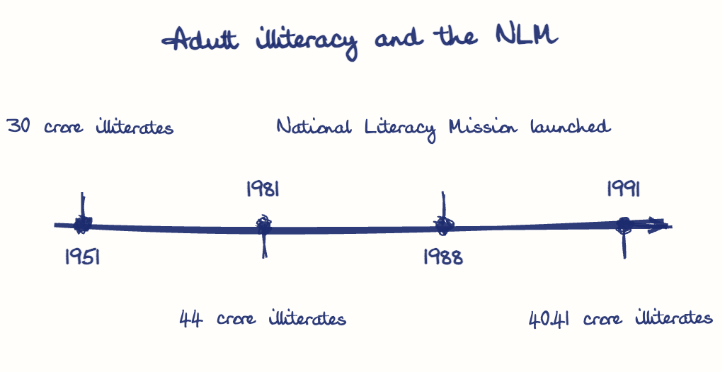
The number of illiterates had risen until 1981 with population growth and began to decline after the mission’s launch; female literacy lagged due to social mindsets, addressed by Beti Bachao Beti Padhao and Swachh Vidyalaya initiatives in Andhra Pradesh, which improved school infrastructure and social attitudes.
Volunteerism and Functional Literacy
Declining volunteer spirit weakened the mission; functional literacy raised awareness on health, rights, and family planning, supported by newer programmes like Saakshar Bharat and Padhna Likhna Abhiyan, which reinforced literacy’s socio-economic impact.
Community and Technology
Revitalizing volunteerism and leveraging Digital India2 and BharatNet can enhance literacy in rural and tribal areas, ensuring access to digital tools and connectivity for adult learners.
Gender and Skill Focus
Targeted female literacy interventions and linking literacy with livelihood schemes like Deendayal Antyodaya Yojana can boost empowerment and economic participation, making literacy more relevant and sustainable.
This model answer is indicative and the model can make mistakes; please verify key facts independently.
Practise this question
1Get the answer sheet
Sized for this question.
2Write your answer
Timed, by hand.
3Get it marked
Your score and what to fix.
This chapter in the exam
Science, Technology & Innovation: policies, institutions, achievements20 questions
Asked in 7 of 8 sittings since 2008
Most tested: Science and technology policy and mission-mode institutions
- 2025Evaluate the impact of Internet of Things (IoT) technologies on the automation of household systems. Illustrate how everyday tasks have evolved due to IoT innovations.
- 2025Which are the major scientific institutes located in Andhra Pradesh? Discuss the role of IISER Tirupati in the scientific and educational development of the state.
All 20 questions, sorted by sub-topic, with model answers and practice.
Question from the official APPSC Group-I Mains 2012 paper. Answer written by Ghissu's engine and checked against our editorial standards. Found an error? Tell us and we correct it within 48 hours.