Analyze the role of communalism in the partition of the country.
In short
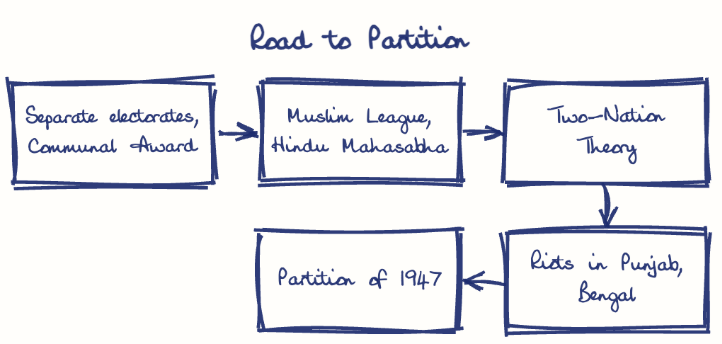
Communalism was both cause and consequence of partition: separate electorates and the Communal Award politicised religion, the Muslim League's Two-Nation Theory and recurring riots made coexistence seem untenable, and inclusive nationalism failed. Partition triggered mass migration and violence that killed nearly half a million people, especially in Punjab and Bengal.
Model answer
Ghissu Editorial · Verified 4 Oct 2026 · 296 words
Colonial Divide-and-Rule Policy
British introduced separate electorates and the Communal Award, institutionalizing communal identities and fostering Hindu-Muslim mistrust. This policy politicized religion and fragmented the nationalist movement by encouraging competition for political power along communal lines.
Rise of Separate Political Identities
The Muslim League and Hindu Mahasabha politicized religion, culminating in the Two-Nation Theory1 advocating separate homelands. The League’s demand for Pakistan was rooted in fears of Muslim marginalization, while Hindu nationalist groups emphasized Hindu identity, polarizing communities further.
Mass Violence and Displacement
Partition caused one of history’s largest migrations, with nearly half a million deaths and deep trauma, especially in Punjab and Bengal. Communal riots created cycles of retaliation, shattering social harmony and leaving lasting scars on collective memory.
Electoral Reforms and Dialogue
Implementing Tarkunde Committee recommendations to reform electoral processes and discouraging identity-based politics, alongside promoting sustained inter-community dialogue, can reduce communal tensions and build trust.
Secular Education and Legal Safeguards
Strengthening curricula to emphasize India’s composite culture and enforcing strict laws against communal hate speech are vital to counter divisive ideologies and foster unity.
This model answer is indicative and the model can make mistakes; please verify key facts independently.
Practise this question
1Get the answer sheet
Sized for this question.
2Write your answer
Timed, by hand.
3Get it marked
Your score and what to fix.
This chapter in the exam
Indian Nationalism in Three Phases; Independence, Partition and After22 questions
Asked in 8 of 8 sittings since 2008
Most tested: Gandhian mass movements and their impact, alongside peasant mobilisation and communalism/partition.
- 2025Discuss the role and contributions of the moderate leaders of Congress from 1885 to 1905.
- 2025Describe the major movements led by Mahatma Gandhi between 1920 and 1947.
All 22 questions, sorted by sub-topic, with model answers and practice.
Question from the official APPSC Group-I Mains 2016 paper. Answer written by Ghissu's engine and checked against our editorial standards. Found an error? Tell us and we correct it within 48 hours.