Comment on the contribution of peasant movements in freedom struggle.
In short
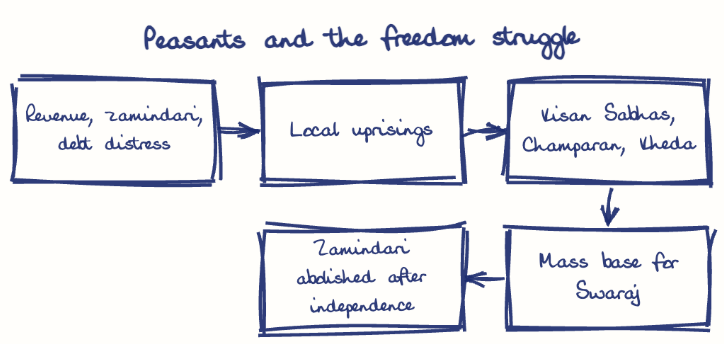
Peasant movements turned the freedom struggle from an elite campaign into a mass movement by linking agrarian distress with the demand for Swaraj. Champaran, Kheda and Bardoli under Gandhi and Patel, the Kisan Sabhas and the Telangana armed struggle gave the movement its rural depth.
Model answer
Ghissu Editorial · Verified 4 Oct 2026 · 276 words
Economic Grievances as Catalyst
High land revenue, zamindari oppression and indebtedness to moneylenders created widespread agrarian distress that became the foundation for organized resistance.
Mass Mobilization
Movements united owner-cultivators, sharecroppers and landless labourers, and the Kisan Sabhas (All India Kisan Sabha, 1936) gave them lasting organization.
Limitations
Many early uprisings were local and aimed at landlords rather than colonial rule, which limited their revolutionary scope.
Integration with Nationalist Leadership
Gandhi and Sardar Patel linked agrarian distress with Swaraj in Champaran (1917), Kheda (1918) and Bardoli (1928), broadening the Congress base in the countryside.
Radical Currents
Communist and socialist leaders in the Tebhaga movement and the Telangana armed struggle1 against the Nizam’s feudal order added a sharper critique of landlordism, and women played a notable role in the Telangana struggle.
Land Reforms
Peasant pressure shaped post-independence zamindari abolition and tenancy laws.
Rural Political Empowerment
They brought agrarian issues into democratic politics after 1947.
This model answer is indicative and the model can make mistakes; please verify key facts independently.
Sources
Practise this question
1Get the answer sheet
Sized for this question.
2Write your answer
Timed, by hand.
3Get it marked
Your score and what to fix.
This chapter in the exam
Indian Nationalism in Three Phases; Independence, Partition and After22 questions
Asked in 8 of 8 sittings since 2008
Most tested: Gandhian mass movements and their impact, alongside peasant mobilisation and communalism/partition.
- 2025Discuss the role and contributions of the moderate leaders of Congress from 1885 to 1905.
- 2025Describe the major movements led by Mahatma Gandhi between 1920 and 1947.
All 22 questions, sorted by sub-topic, with model answers and practice.
Question from the official APPSC Group-I Mains 2016 paper. Answer written by Ghissu's engine and checked against our editorial standards. Found an error? Tell us and we correct it within 48 hours.