Comment on the effectiveness of the methods employed by Mahatma Gandhi to mobilize masses?
In short
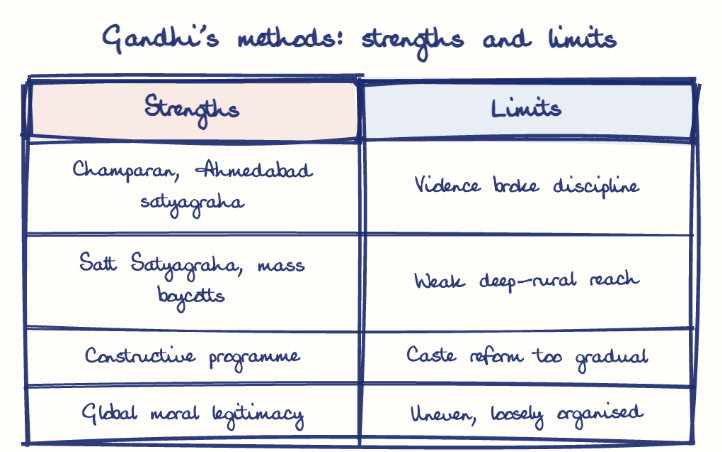
Gandhi's Satyagraha, civil disobedience, boycotts and constructive work were highly effective in turning the freedom struggle into a mass movement, though discipline and caste divides limited them. In Andhra, Non-Cooperation took local forms like the Chirala-Perala movement, the Pedanandipadu no-tax campaign and the Palnadu forest satyagraha.
Model answer
Ghissu Editorial · Verified 4 Oct 2026 · 264 words
Non-violent Resistance and Satyagraha
Gandhi pioneered Satyagraha, tested in Champaran and Ahmedabad, using peaceful protests and hunger strikes to address peasant and labor grievances.
Mass Civil Disobedience and Boycotts
Movements like the Non-Cooperation Movement and Salt Satyagraha mobilized millions, including women and marginalized communities, by boycotting British goods and taxes.
Broad-based Participation and National Integration
Gandhi’s strategies expanded nationalism to peasants, artisans, women, and Dalits, with the Andhra region exemplifying effective local leadership through the Chirala-Perala and Pedanandipadu campaigns.
Moral High Ground and Global Legacy1
The non-violent approach attracted international support, inspiring civil rights leaders like Martin Luther King Jr. and Nelson Mandela; the UN’s October 2 International Day of Non-Violence reflects this legacy.
Limitations in Sustaining Discipline and Addressing Social Divides
Spontaneous violence post-Rowlatt Act and resistance from orthodox groups limited caste abolition and communal unity efforts, disappointing reformers like Ambedkar.
Challenges in Rural Penetration and Political Outcomes
Urban centers saw more impact than rural areas; lack of centralized organization caused uneven momentum, as in the halted Non-Cooperation Movement.
Strengthen Grassroots Institutions
Revive Gram Swaraj and self-help groups for deeper democratic participation.
Integrate Social Reform with Political Mobilization
Address caste and communal divides through inclusive policies.
This model answer is indicative and the model can make mistakes; please verify key facts independently.
Sources
Practise this question
1Get the answer sheet
Sized for this question.
2Write your answer
Timed, by hand.
3Get it marked
Your score and what to fix.
This chapter in the exam
Indian Nationalism in Three Phases; Independence, Partition and After22 questions
Asked in 8 of 8 sittings since 2008
Most tested: Gandhian mass movements and their impact, alongside peasant mobilisation and communalism/partition.
- 2025Discuss the role and contributions of the moderate leaders of Congress from 1885 to 1905.
- 2025Describe the major movements led by Mahatma Gandhi between 1920 and 1947.
All 22 questions, sorted by sub-topic, with model answers and practice.
Question from the official APPSC Group-I Mains 2016 paper. Answer written by Ghissu's engine and checked against our editorial standards. Found an error? Tell us and we correct it within 48 hours.