Compare Hinayana and Mahayana Buddhism. Why did Buddhism become popular and decline subsequently?
In short
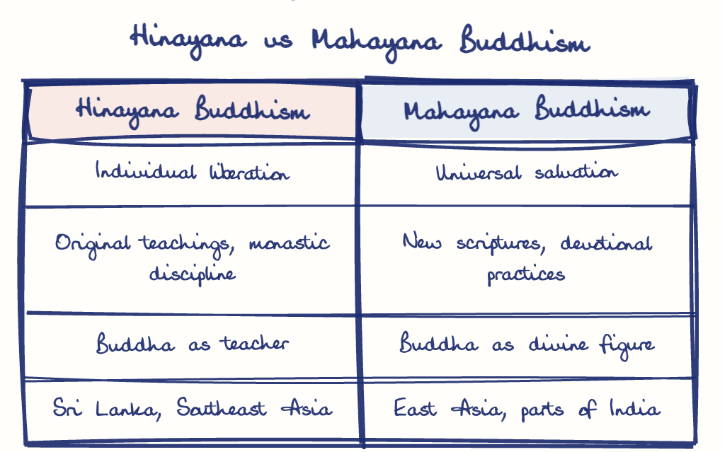
Hinayana stresses individual liberation through the Pali Canon and austere monastic discipline, while Mahayana offers universal salvation through the Bodhisattva ideal, new sutras and worship of Buddha as divine. Buddhism spread through inclusiveness and royal patronage by Ashoka and Kanishka, but declined through monastic decadence, Brahmanical revival and Turkish invasions.
Model answer
Ghissu Editorial · Verified 4 Oct 2026 · 356 words
Philosophical Orientation
Hinayana (Theravada) stresses personal enlightenment via strict adherence to the Pali Canon; Mahayana emphasizes universal salvation and the Bodhisattva ideal, promoting compassion for all beings.
Scriptural and Ritual Differences
Hinayana relies on early Pali scriptures and austere monastic discipline; Mahayana incorporates new sutras like Prajnaparamita and Vaipulya, with elaborate rituals and worship of multiple Buddhas and Bodhisattvas.
Social Inclusiveness and Royal Patronage
Buddhism’s rejection of the varna system attracted lower castes and women; Emperor Ashoka’s missionary efforts spread it widely across Asia, establishing it as a major religion.
Philosophical Appeal and Adaptability
The Four Noble Truths2 offered practical guidance to overcome suffering; Mahayana’s syncretism helped it flourish in regions like Andhra Pradesh, inspiring the Amaravati school of art and integrating local beliefs.
Internal Corruption and Loss of Patronage
Wealth accumulation led to monastic decadence, alienating followers; after the Mauryan era, rulers increasingly favored Brahmanism, reducing state support for Buddhism.
Brahmanical Revival and Sectarian Divisions
Scholars like Shankaracharya and Kumaril Bhatta reasserted Hindu dominance; the shift from Pali to Sanskrit and divisions between Hinayana and Mahayana weakened Buddhism’s mass appeal.
External Invasions
Turkish invasions targeted wealthy monasteries, causing physical destruction and accelerating Buddhism’s decline in India.
This model answer is indicative and the model can make mistakes; please verify key facts independently.
Practise this question
1Get the answer sheet
Sized for this question.
2Write your answer
Timed, by hand.
3Get it marked
Your score and what to fix.
This chapter in the exam
Ancient India - Pre-history, IVC, Vedic, Mauryas, Kushans, Satavahanas, Sangam, Guptas16 questions
Asked in 8 of 8 sittings since 2008
Most tested: Harappan civilisation—urban planning, origin/decline, and continuity.
- 2025Discuss the origin and expansion of the Indus Valley Civilization.
- 2025Briefly analyze the teachings of Buddha and Mahavira.
All 16 questions, sorted by sub-topic, with model answers and practice.
Question from the official APPSC Group-I Mains 2016 paper. Answer written by Ghissu's engine and checked against our editorial standards. Found an error? Tell us and we correct it within 48 hours.