Describe the nature and significance of revolt of 1857? Explain whether it can be termed as "First War of Independence"?
In short
The Revolt of 1857 was a multi-class uprising of sepoys, peasants, landlords and princes, but it was regionally fragmented and lacked a unified nationalist ideology, so the "First War of Independence" label is contested. Its lasting significance was ending Company rule through the Government of India Act 1858.
Model answer
Ghissu Editorial · Verified 4 Oct 2026 · 278 words
End of Company Rule
The revolt led to the British Crown taking direct control under the Government of India Act 1858, marked by Queen Victoria’s Proclamation at Allahabad, which promised non-interference in religious matters.
Policy Shift Towards Princes
British stopped annexations, respecting native princes’ sovereignty to stabilize governance and integrate princely states under Crown paramountcy.
Multi-class and Regional Participation
Sepoys, peasants, landlords, and some princes across northern and central India participated, reflecting broad discontent beyond a mere military mutiny.
Fragmented Uprising
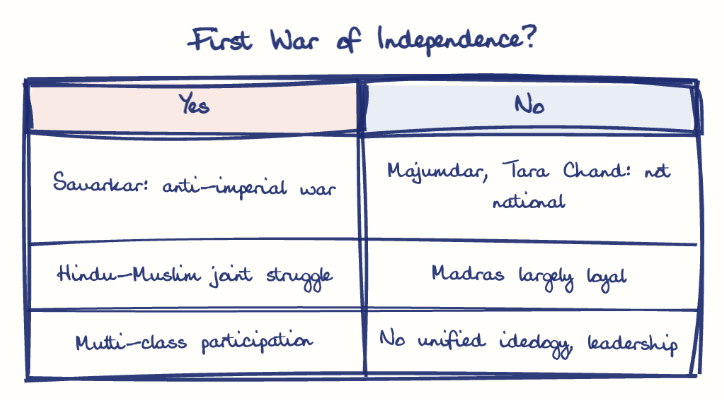
The revolt was localized, with southern presidencies like Madras loyal to the British, lacking unified leadership or nationalism; it suffered from poor coordination and internal divisions.
Symbol of Resistance
It was the first major collective anti-colonial challenge, inspiring later nationalist movements and sowing seeds for organized freedom struggle.
Historiographical Debates
Nationalists like V.D. Savarkar hailed it as the "First War of Independence," emphasizing its anti-imperial character, while historians like R.C. Majumdar argued it lacked political unity and pan-Indian scope.
Inclusive Narratives
Promote balanced historiography acknowledging both limitations and significance, fostering nuanced understanding in education.
Preserving Memories
Commemorate diverse participants, including subaltern and regional actors, through heritage projects to deepen public engagement with India’s freedom struggle.
This model answer is indicative and the model can make mistakes; please verify key facts independently.
Sources
Practise this question
1Get the answer sheet
Sized for this question.
2Write your answer
Timed, by hand.
3Get it marked
Your score and what to fix.
This chapter in the exam
British Rule 1757-1856, the 1857 Revolt, Socio-Religious Reform & the Rise of Nationalism20 questions
Asked in 8 of 8 sittings since 2008
Most tested: Colonialism’s impact on Indian society/economy and reform-led social uplift, especially untouchability and caste reform.
- 2025What do you understand by the Permanent Settlement, and what impact did it have on Indian society? Comment.
- 2025What do you understand by the 'safety valve' theory? Explain it in the context of the Indian National Congress?
All 20 questions, sorted by sub-topic, with model answers and practice.
Question from the official APPSC Group-I Mains 2016 paper. Answer written by Ghissu's engine and checked against our editorial standards. Found an error? Tell us and we correct it within 48 hours.