"We must hold fast to constitutional methods for achieving our social and economical objectives". Briefly explain the significance of this statement of Dr B. R. Ambedkar with reference to his achievements. Also explain its relevance in the present to protect democracy?
In short
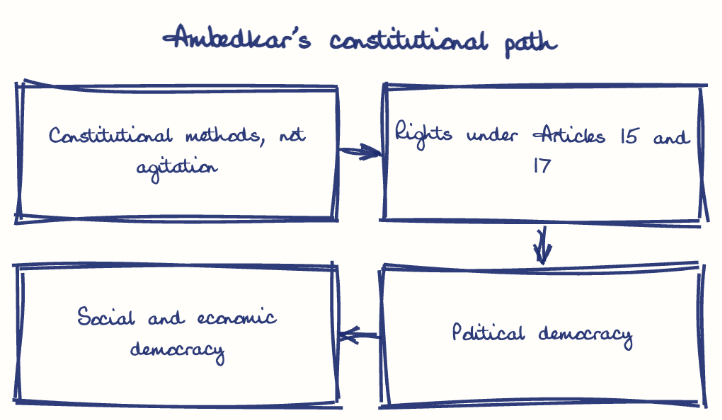
Ambedkar's call, made in his 25 November 1949 speech to the Constituent Assembly, means social and economic change must come through law and institutions, not civil disobedience or hero-worship. His Constitution and constitutional morality embody it, and today it guards democracy against populism, personality cults and extra-legal agitation.
Model answer
Ghissu Editorial · Verified 4 Oct 2026 · 255 words
Linking Political and Social Democracy
He highlighted that political democracy is incomplete without social justice, achievable through constitutional frameworks bridging rights and economic empowerment, as reflected in his advocacy for affirmative action.
Architect of the Indian Constitution
As Drafting Committee Chairman, Ambedkar embedded equality, liberty, and fraternity, with provisions like Articles 15 and 17 promoting affirmative action and abolishing untouchability, laying a legal foundation for social reform.
Countering Populism and Authoritarianism
Ambedkar’s warning against personality cults is pertinent as democratic institutions face pressures from charismatic leaders, emphasizing institutional supremacy over individual dominance.
Addressing Inequalities Constitutionally
Persistent social and economic disparities require constitutional solutions like welfare schemes (e.g., Mahatma Gandhi National Rural Employment Guarantee Act) rather than extra-legal protests, ensuring inclusive development.
Strengthen Civic Education and Institutional Accountability
Promote constitutional awareness and empower judiciary and Election Commission to uphold norms, ensuring adherence to constitutional methods.
Promote Inclusive Governance
Ensure marginalized groups participate meaningfully in policy-making, reflecting Ambedkar’s vision of social justice through democratic processes.
This model answer is indicative and the model can make mistakes; please verify key facts independently.
Sources
Practise this question
1Get the answer sheet
Sized for this question.
2Write your answer
Timed, by hand.
3Get it marked
Your score and what to fix.
This chapter in the exam
British Rule 1757-1856, the 1857 Revolt, Socio-Religious Reform & the Rise of Nationalism20 questions
Asked in 8 of 8 sittings since 2008
Most tested: Colonialism’s impact on Indian society/economy and reform-led social uplift, especially untouchability and caste reform.
- 2025What do you understand by the Permanent Settlement, and what impact did it have on Indian society? Comment.
- 2025What do you understand by the 'safety valve' theory? Explain it in the context of the Indian National Congress?
All 20 questions, sorted by sub-topic, with model answers and practice.
Question from the official APPSC Group-I Mains 2016 paper. Answer written by Ghissu's engine and checked against our editorial standards. Found an error? Tell us and we correct it within 48 hours.