Who are Razakars and what was their role in resisting integration of Hyderabad State in the Indian union?
In short
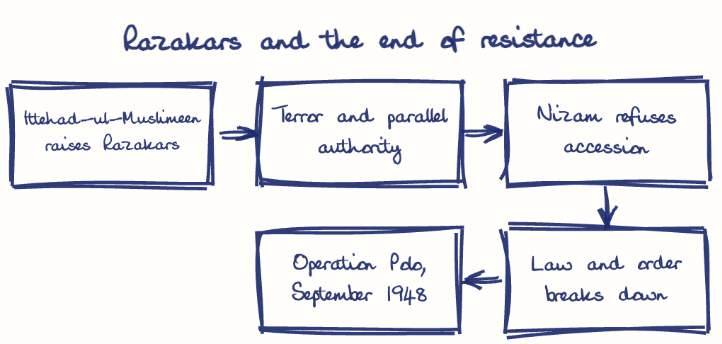
The Razakars were a militant paramilitary force of the Ittehad-ul-Muslimeen led by Kasim Razvi, which sought to keep Hyderabad independent under the Nizam through terror against villagers and communal intimidation. Their violence justified Operation Polo in September 1948, which ended the Nizam's rule and integrated Hyderabad into India.
Model answer
Ghissu Editorial · Verified 4 Oct 2026 · 284 words
Formation under Ittehad-ul-Muslimeen
The Razakars were formed by the Ittehad-ul-Muslimeen, led by Kasim Razvi, who sought Muslim dominance and Hyderabad’s sovereignty.
Mass Mobilization and Religious Zeal
By 1948, the Razakars had grown to an estimated one to two lakh members, taking an oath in Allah’s name to defend Muslim supremacy, reflecting their communal and religious motivations.
Terror and Political Challenge
They terrorised Hindu villagers and suppressed dissent; the Hyderabad State Congress struggled against them, while Communists gained rural support by protecting villagers and leading peasant revolts.
Justification for Police Action
Their violence prompted Sardar Patel’s “Operation Polo” in 1948 to annex Hyderabad forcibly.
Acceleration of Integration Process
The Razakars undermined the Nizam’s position, hastening Hyderabad’s absorption into India.
Political Realignment
Post-annexation, Razakar leaders were arrested, and Congress and Communist parties shaped Hyderabad’s democratic transition.
Strengthen Local Governance
Empower Panchayati Raj Institutions via Rashtriya Gram Swaraj Abhiyan to promote inclusive development and reduce communal tensions.
Promote Communal Harmony and Education
Foster interfaith dialogue and develop balanced educational materials on Hyderabad’s integration to heal historical wounds and prevent communal distortions.
This model answer is indicative and the model can make mistakes; please verify key facts independently.
Practise this question
1Get the answer sheet
Sized for this question.
2Write your answer
Timed, by hand.
3Get it marked
Your score and what to fix.
This chapter in the exam
Indian Nationalism in Three Phases; Independence, Partition and After22 questions
Asked in 8 of 8 sittings since 2008
Most tested: Gandhian mass movements and their impact, alongside peasant mobilisation and communalism/partition.
- 2025Discuss the role and contributions of the moderate leaders of Congress from 1885 to 1905.
- 2025Describe the major movements led by Mahatma Gandhi between 1920 and 1947.
All 22 questions, sorted by sub-topic, with model answers and practice.
Question from the official APPSC Group-I Mains 2016 paper. Answer written by Ghissu's engine and checked against our editorial standards. Found an error? Tell us and we correct it within 48 hours.