Describe the procedure for amending the constitution? What is the criticism against it?
In short
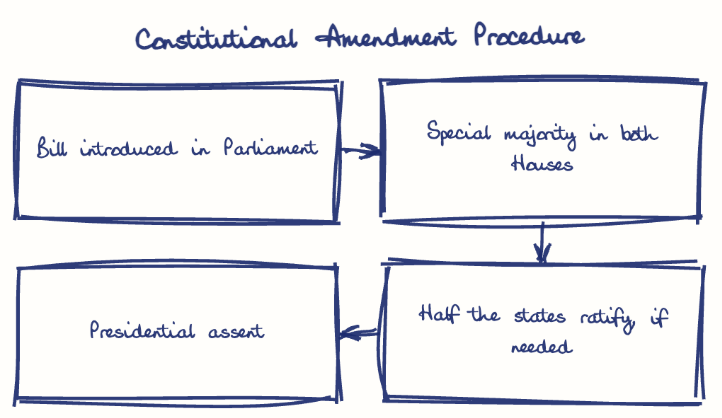
Under Article 368, an amendment bill is introduced only in Parliament, passed by a special majority in each House, ratified by half the states if federal provisions are affected, and then receives mandatory Presidential assent. Critics cite the weak role of states, no ratification deadline and no joint sitting.
Model answer
Ghissu Editorial · Verified 4 Oct 2026 · 291 words
Parliamentary Initiation and Special Majority
Amendments can only be introduced in Parliament by ministers or private members and require a special majority, meaning a majority of total members plus two-thirds of those present and voting. There is no provision for joint sittings to resolve deadlocks between the two Houses, unlike ordinary legislation.
State Ratification for Federal Provisions
Amendments affecting federal features such as the President’s election, state representation in Parliament, or distribution of powers require ratification by at least half the state legislatures by simple majority. There is no prescribed time limit for this ratification, which risks indefinite delays and uncertainty in constitutional reforms.
Political Misuse and Basic Structure Clash
The 130th Amendment Bill (2025) highlights tensions between parliamentary supremacy and the Basic Structure Doctrine, as it sought automatic removal of ministers, raising concerns about bypassing constitutional safeguards and judicial review.
Mandate Time Limits for Ratification
Introducing deadlines for state ratification would prevent indefinite delays and enhance the predictability and efficiency of the amendment process.
This model answer is indicative and the model can make mistakes; please verify key facts independently.
Practise this question
1Get the answer sheet
Sized for this question.
2Write your answer
Timed, by hand.
3Get it marked
Your score and what to fix.
This chapter in the exam
Judiciary in India15 questions
Asked in 8 of 8 sittings since 2008
Most tested: Judicial review and its scope/limits
- 2025What are the emergency functions of the Union Government of India? Describe how they impact the legislative powers of Parliament and State Legislatures.
- 2025Discuss any two constitutional amendments that have significantly affected the powers or functioning of the Indian judiciary.
All 15 questions, sorted by sub-topic, with model answers and practice.
Question from the official APPSC Group-I Mains 2016 paper. Answer written by Ghissu's engine and checked against our editorial standards. Found an error? Tell us and we correct it within 48 hours.