Describe the various special provisions in the constitution relating to scheduled castes, scheduled tribes, backward classes and Anglo-Indians.
In short
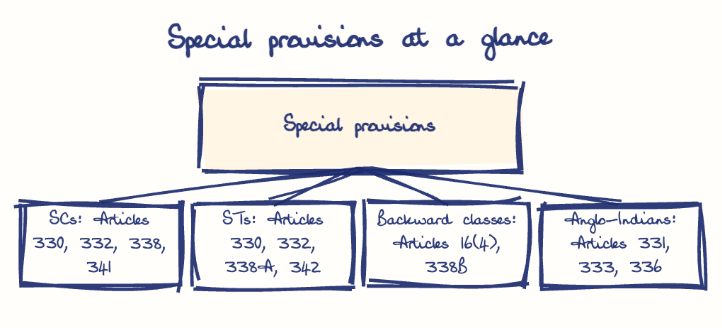
The Constitution grants SCs and STs reserved legislative seats (Articles 330 and 332), service reservations (Articles 16(4) and 335), presidential lists (Articles 341 and 342) and national commissions, with similar provisions for backward classes, and once gave Anglo-Indians nominated seats. The 104th Amendment ended Anglo-Indian nomination in January 2020.
Model answer
Ghissu Editorial · Verified 4 Oct 2026 · 287 words
Reservation and Specification
Article 341 empowers the President to specify SCs, with parliamentary approval for changes; Articles 330 and 332 reserve seats in legislatures proportional to SC population; Articles 16(4) and 335 govern reservation in services; Article 338 establishes the National Commission for Scheduled Castes.
Judicial Interpretation
In Bhaiyalal v. Harikishan Singh and Ors (Civil Appeal No.765 of 1964) and B. Basavalingappa v. D. Munichinnappa (Civil Appeal No.401 of 1964), the Supreme Court held that the President's list under Article 341 is final and can be changed only by Parliament, not by courts.
Constitutional Safeguards
Article 342 empowers the President to specify STs; Articles 330 and 332 reserve legislative seats; Articles 16(4) and 335 govern reservation in services; Article 338A establishes the National Commission for Scheduled Tribes.
Regional Focus
The commission addresses tribal issues, including in tribal areas of Andhra Pradesh.
Reservation and Identification
Article 16(4) authorizes reservations; the 102nd Amendment empowers the President to specify backward classes; Article 338B establishes the National Commission for Backward Classes.
Commissions and Data
The Kalelkar Commission and the Mandal (Second Backward Classes) Commission have contributed to identifying backward classes and guiding policy, including in Andhra Pradesh.
Representation
Articles 331 and 333 provided for nominated Anglo-Indian members in legislatures to ensure representation, a provision that lapsed in January 2020 under the 104th Amendment.
This model answer is indicative and the model can make mistakes; please verify key facts independently.
Practise this question
1Get the answer sheet
Sized for this question.
2Write your answer
Timed, by hand.
3Get it marked
Your score and what to fix.
This chapter in the exam
Indian Constitution, Fundamental Rights, DPSP and Union-State functions18 questions
Asked in 8 of 8 sittings since 2008
Most tested: Rights, social justice, and constitutional safeguards for disadvantaged groups.
- 2025The Indian Constitution favours a federal type of government. Considering this, what duties does the Constitution place on State Governments to ensure the smooth functioning of the nation?
- 2025The Constitution of India grants certain rights to citizens and also provides measures to safeguard them. What are the key constitutional arrangements to ensure the protection of these rights?
All 18 questions, sorted by sub-topic, with model answers and practice.
Question from the official APPSC Group-I Mains 2016 paper. Answer written by Ghissu's engine and checked against our editorial standards. Found an error? Tell us and we correct it within 48 hours.