What according to the Supreme Court constitutes "the basic structure" of our constitution? Please name a couple of important judgements of the Supreme Court on this issue?
In short
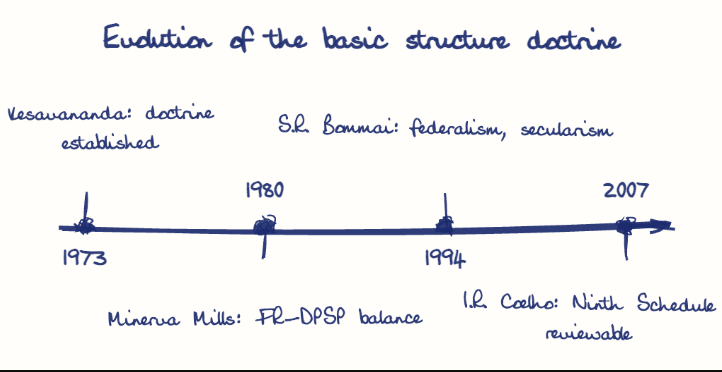
The Supreme Court holds that Parliament cannot amend away the Constitution's basic structure, which includes constitutional supremacy, democracy, secularism, federalism, separation of powers, judicial review, rule of law and fundamental rights. Key judgments are Kesavananda Bharati (1973), Minerva Mills (1980), the Bommai case (1994) and the Coelho case (2007).
Model answer
Ghissu Editorial · Verified 4 Oct 2026 · 272 words
Kesavananda Bharati Case1
The Supreme Court identified essential features like supremacy of the Constitution, secularism, federalism, separation of powers, and unity of the nation as inviolable, limiting Parliament’s amending power.
Key Features
Judicial review, rule of law, independence of judiciary, parliamentary system, fundamental rights, and socio-economic justice are integral parts of the basic structure that preserve constitutional spirit.
Important Judgments
Minerva Mills (1980) reinforced the balance between Fundamental Rights and Directive Principles; S.R. Bommai (1994) emphasized federalism and secularism; I.R. Coelho (2007) upheld judicial review over Ninth Schedule laws, affirming the doctrine’s continuing relevance.
Judicial Role and Challenges
The Supreme Court acts as guardian of the basic structure through judicial review but the wider judiciary carries heavy pendency, with around 1.82 lakh cases pending for over 30 years in High Courts and district courts, which delays constitutional adjudication and affects timely enforcement of constitutional principles.
Clearer Guidelines
The Court should articulate a more precise framework for identifying the basic structure to reduce ambiguity and enhance predictability in constitutional amendments.
Judicial Strengthening
Addressing judicial vacancies, including 371 vacancies in High Courts, and reducing delays will improve the judiciary’s capacity to uphold the basic structure effectively and ensure timely justice.
This model answer is indicative and the model can make mistakes; please verify key facts independently.
Sources
Practise this question
1Get the answer sheet
Sized for this question.
2Write your answer
Timed, by hand.
3Get it marked
Your score and what to fix.
This chapter in the exam
Indian Constitution, Fundamental Rights, DPSP and Union-State functions18 questions
Asked in 8 of 8 sittings since 2008
Most tested: Rights, social justice, and constitutional safeguards for disadvantaged groups.
- 2025The Indian Constitution favours a federal type of government. Considering this, what duties does the Constitution place on State Governments to ensure the smooth functioning of the nation?
- 2025The Constitution of India grants certain rights to citizens and also provides measures to safeguard them. What are the key constitutional arrangements to ensure the protection of these rights?
All 18 questions, sorted by sub-topic, with model answers and practice.
Question from the official APPSC Group-I Mains 2016 paper. Answer written by Ghissu's engine and checked against our editorial standards. Found an error? Tell us and we correct it within 48 hours.