What is concept of cooperative federalism? Does it exist in Indian polity?
In short
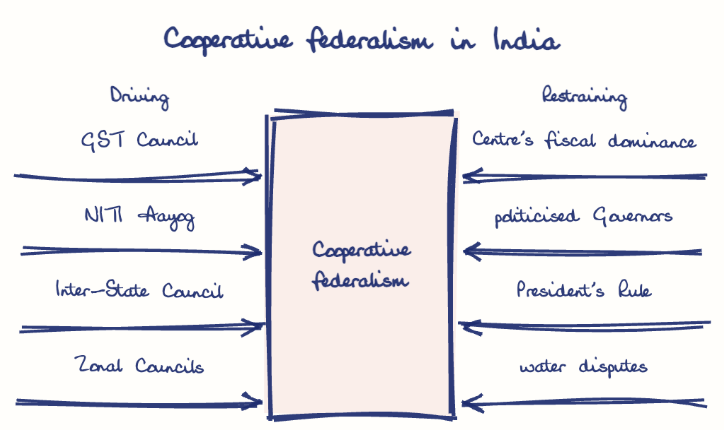
Cooperative federalism is a partnership in which the Centre and states share responsibilities and resources to pursue common goals rather than acting in separate spheres, and it exists in India alongside centralising and competitive tendencies. The GST Council, where Centre and states jointly set tax rates, is its clearest example.
Model answer
Ghissu Editorial · Verified 4 Oct 2026 · 259 words
Collaborative Model vs Classical Federalism
Cooperative federalism stresses shared governance and joint decision-making, unlike K.C. Wheare’s model that advocates for independent functioning within separate jurisdictions.
Constitutional and Administrative Tools
Articles 263 and 261, the 7th Schedule, and bodies like the Inter-State Council institutionalize cooperation by facilitating coordination and mutual respect among governments.
Evidence of Cooperation
The GST Council exemplifies pooled sovereignty where Centre and states, including Andhra Pradesh, jointly decide tax policies. The 14th and 15th Finance Commissions have enhanced fiscal federalism by increasing states’ financial autonomy and recommending performance-based grants.
Challenges and Conflicts
Water disputes over Krishna and Godavari rivers in Andhra Pradesh and politicisation of Governors reveal limits to cooperation and centralising tendencies that strain Centre-state relations.
Strengthen Institutions and Fiscal Autonomy
Empower the Inter-State Council and GST Council with greater authority and ensure regular meetings. Increase untied grants and reduce conditionalities in Centrally Sponsored Schemes to give states like Andhra Pradesh more flexibility.
Inclusive Policy-Making and Dispute Resolution
Platforms like NITI Aayog should involve states comprehensively in policy formulation. Establish permanent mechanisms for resolving inter-state conflicts, especially on resource sharing, to prevent confrontational federalism and promote harmony.
This model answer is indicative and the model can make mistakes; please verify key facts independently.
Practise this question
1Get the answer sheet
Sized for this question.
2Write your answer
Timed, by hand.
3Get it marked
Your score and what to fix.
This chapter in the exam
Federal structure, Governor and distribution of powers17 questions
Asked in 8 of 8 sittings since 2008
Most tested: Centre–State balance and the extent of Union supremacy over States
- 2025The procedure of enacting a law from a bill differs at the Union and State levels, primarily to safeguard the interests of the Union Government in state legislation. Elucidate this aspect.
- 2025Although States have their separate list for law-making, this authority is not beyond the overarching legislative powers of the Parliament. Examine.
All 17 questions, sorted by sub-topic, with model answers and practice.
Question from the official APPSC Group-I Mains 2016 paper. Answer written by Ghissu's engine and checked against our editorial standards. Found an error? Tell us and we correct it within 48 hours.