What is meant by "judicial activism"? What is its impact on Indian polity?
In short
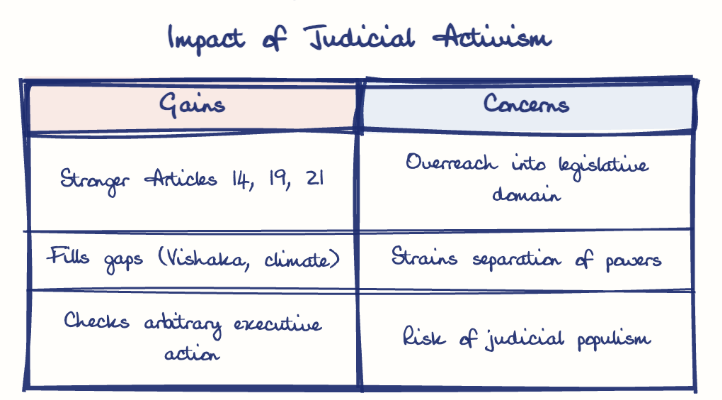
Judicial activism is the judiciary's proactive use of interpretation to protect rights and promote justice when the legislature or executive falters, going beyond strict adjudication. It has strengthened rights, as in Maneka Gandhi (1978) and the Vishaka guidelines (1997), but risks overreach into the other branches' domains.
Model answer
Ghissu Editorial · Verified 4 Oct 2026 · 242 words
Proactive Judicial Role
It involves courts interpreting laws to protect fundamental rights and enforce constitutional duties, as seen in Maneka Gandhi v. Union of India (1978), which expanded the scope of Article 21.
Judicial Law-Making
Courts fill legislative gaps through policy decisions, exemplified by the Vishaka Guidelines (1997) on sexual harassment and the Shayara Bano case (2017) abolishing triple talaq, demonstrating judicial innovation in social reform.
Strengthening Fundamental Rights
Judicial activism reinforces rights under Articles 14, 19, and 21, with recent rulings like Association for Democratic Reforms v. Union of India (2024) enhancing electoral transparency and accountability.
Checks on Executive Overreach
It curbs arbitrary executive power, safeguarding democracy, though risks judicial overreach, as in the National Anthem directive (Shyam Narayan Chouksey case), which raised concerns about separation of powers.
Judicial Accountability
The Law Commission1’s 195th Report proposes a National Judicial Council for transparent accountability without compromising judicial independence.
Judicial Efficiency
Expanding All India Judicial Services, especially in Andhra Pradesh, can reduce vacancies and pendency, enabling courts to focus effectively on activism where necessary.
This model answer is indicative and the model can make mistakes; please verify key facts independently.
Practise this question
1Get the answer sheet
Sized for this question.
2Write your answer
Timed, by hand.
3Get it marked
Your score and what to fix.
This chapter in the exam
Judiciary in India15 questions
Asked in 8 of 8 sittings since 2008
Most tested: Judicial review and its scope/limits
- 2025What are the emergency functions of the Union Government of India? Describe how they impact the legislative powers of Parliament and State Legislatures.
- 2025Discuss any two constitutional amendments that have significantly affected the powers or functioning of the Indian judiciary.
All 15 questions, sorted by sub-topic, with model answers and practice.
Question from the official APPSC Group-I Mains 2016 paper. Answer written by Ghissu's engine and checked against our editorial standards. Found an error? Tell us and we correct it within 48 hours.