Discuss briefly the guiding principles in setting up the NITI Aayog.
In short
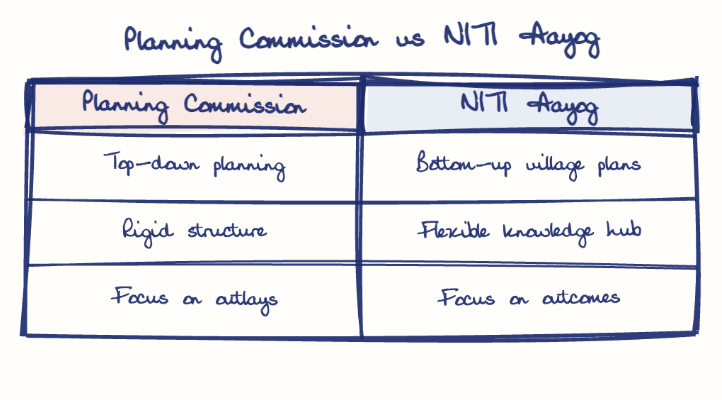
NITI Aayog, set up in 2015 to replace the Planning Commission, rests on cooperative federalism, bottom-up planning from the village level, expert-driven flexibility, Antyodaya and outcome-focused good governance. Its Governing Council includes all Chief Ministers, and the Aspirational Districts Programme covering 112 districts puts these principles into practice.
Model answer
Ghissu Editorial · Verified 4 Oct 2026 · 266 words
Networked Governance Model
The Prime Minister chairs the Governing Council1 with all Chief Ministers, institutionalizing cooperative federalism and ensuring active state participation in policy formulation.
Expertise and Flexibility
Functions as a knowledge network providing strategic advice, drawing on experts from academia and research institutions, unlike the rigid Planning Commission.
Good Governance Focus
Prioritizes transparency and accountability, inspired by Chanakya’s governance principles, shifting focus from budget outlays to measurable outcomes.
Cooperative Federalism in Practice
Created 26 State Institutions for Transformation and regional councils2 addressing inter-state issues, including Andhra Pradesh water disputes and regional development challenges.
Inclusive Development
Implements Aspirational Districts and Blocks Programmes in backward regions like Andhra Pradesh, targeting upliftment of marginalized groups through focused interventions.
Data-Driven Monitoring
Tracks 49 KPIs in aspirational districts using real-time data analytics, enabling adaptive governance and mid-course corrections to improve outcomes.
Data Transparency
Expanding the Research & Networking3 Division and adopting open data policies would enhance evidence-based policymaking and public trust.
Participative Governance
Leveraging digital platforms and deepening citizen engagement can make governance more inclusive, aligning with NITI Aayog’s principle of people’s participation.
This model answer is indicative and the model can make mistakes; please verify key facts independently.
Practise this question
1Get the answer sheet
Sized for this question.
2Write your answer
Timed, by hand.
3Get it marked
Your score and what to fix.
This chapter in the exam
Government Budgeting (Union)15 questions
Asked in 6 of 8 sittings since 2008
Most tested: Finance Commission, deficits, and fiscal consolidation in the Indian federal budget system.
- 2025What do you understand by Government Budget? Briefly explain the types of public expenditure and how these expenditures are classified in the government budget.
- 2025Define the term 'deficit' in government finance. Explain the various types of deficits and their economic implications.
All 15 questions, sorted by sub-topic, with model answers and practice.
Question from the official APPSC Group-I Mains 2016 paper. Answer written by Ghissu's engine and checked against our editorial standards. Found an error? Tell us and we correct it within 48 hours.