Explain the possible limitations in the strategy for poverty alleviation adopted by the Government of India.
In short
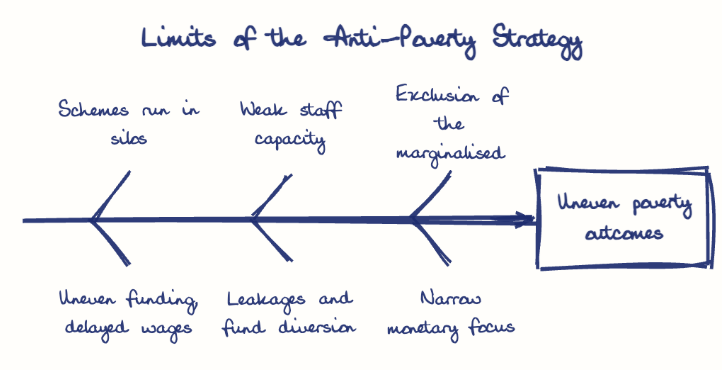
India's poverty alleviation strategy is limited by fragmented schemes, inconsistent funding, weak institutional capacity, leakages, a narrow focus on monetary benefits and exclusion of marginalised groups. Though multidimensional poverty fell from 29.17% in 2013-14 to 11.28% in 2022-23, 364 million Indians remain multidimensionally poor.
Model answer
Ghissu Editorial · Verified 4 Oct 2026 · 268 words
Fragmented Governance
Schemes like MGNREGA, National Food Security Act, and PDS function in isolation, causing duplication and weak convergence that dilute impact.
Exclusion of Marginalised Groups
Dalits and Adivasis face barriers in accessing PDS due to documentation issues; spatial disparities persist, notably in Rayalaseema, Andhra Pradesh, where drought and underdevelopment exacerbate poverty.
Weak Monitoring
Lack of real-time data limits adaptive policy-making in schemes like National Rural Livelihood Mission, delaying course corrections and reducing effectiveness.
Integrated Governance
Promote convergence of schemes for holistic poverty reduction, e.g., linking Purvodaya and Skill India Digital Platform to address multiple deprivation dimensions simultaneously.
Transparency and Inclusion
Use digital audits and beneficiary tracking to reduce leakages; expand outreach via PM Internship Scheme and Employment Linked Incentive (ELI) Scheme to include marginalised groups effectively.
This model answer is indicative and the model can make mistakes; please verify key facts independently.
Practise this question
1Get the answer sheet
Sized for this question.
2Write your answer
Timed, by hand.
3Get it marked
Your score and what to fix.
This chapter in the exam
Inclusive Growth: India and AP schemes49 questions
Asked in 8 of 8 sittings since 2008
Most tested: Women empowerment and poverty reduction through AP welfare and credit-linked institutions
- 2025Elaborate on the meaning of Inclusive Growth in the context of the Indian economy. Discuss the key strategies and instruments that can be employed to foster greater inclusion and ensure that the benefits of economic growth reach all sections of society.
- 2025Critically Examine the major poverty alleviation and employment generation programmes in India. How effective have they been in addressing rural and urban poverty?
All 49 questions, sorted by sub-topic, with model answers and practice.
Question from the official APPSC Group-I Mains 2016 paper. Answer written by Ghissu's engine and checked against our editorial standards. Found an error? Tell us and we correct it within 48 hours.