Classify dams based on structure and design.
In short
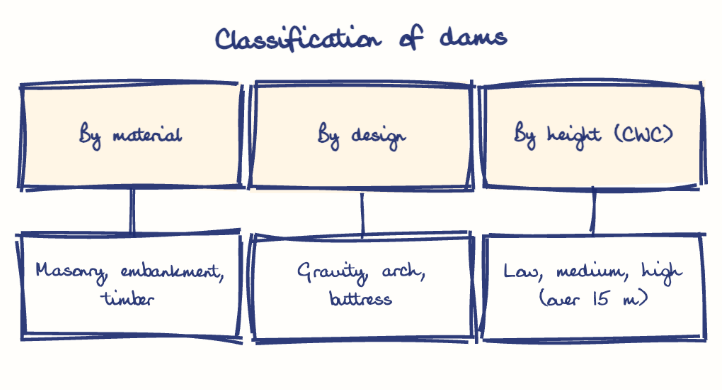
By material, dams are masonry (concrete or stone), embankment (earth or rock-fill) or timber, and by design they are gravity, arch or buttress dams, with low, medium and high classes by height. Their safety is regulated by the National Dam Safety Authority under the Dam Safety Act 2021.
Model answer
Ghissu Editorial · Verified 4 Oct 2026 · 262 words
Regulatory Oversight
The National Dam Safety Authority (NDSA), established under the Dam Safety Act 2021, governs dam safety nationwide, including large projects like Polavaram in Andhra Pradesh, ensuring structural integrity and risk mitigation.
Height-Based Categories
The Central Water Commission classifies dams as low, medium, or high, with large dams exceeding 15 meters, a category that includes major Andhra Pradesh projects like Polavaram, influencing design and safety protocols.
Multi-Purpose Design Complexities
Dams like Polavaram serve irrigation, hydropower, and flood control, requiring complex features such as spillways, flood cushions, and sediment management to balance competing demands and environmental concerns.
Advanced Monitoring Systems
Tools like the Dam Health and Rehabilitation Monitoring Application (DHARMA) provide real-time safety data for dams in Andhra Pradesh, enhancing early warning and maintenance efficiency.
Seismic-Resistant Structures
Designs in earthquake-prone areas incorporate flexible materials and reinforced foundations, crucial for dams sited in higher seismic zones, improving resilience against seismic events.
Uniform Safety Standards
Adopt regionally adaptable design and safety standards across Andhra Pradesh to address local geological and climatic conditions effectively.
Enhanced Institutional Coordination
Improve collaboration between NDSA, state bodies, and local authorities for integrated dam design, operation, and emergency preparedness, ensuring comprehensive safety management.
This model answer is indicative and the model can make mistakes; please verify key facts independently.
Practise this question
1Get the answer sheet
Sized for this question.
2Write your answer
Timed, by hand.
3Get it marked
Your score and what to fix.
This chapter in the exam
Development vs Environment: natural resources, climate change, EIA, natural disasters48 questions
Asked in 8 of 8 sittings since 2008
Most tested: Climate change and mining/environmental degradation links
- 2025Explain the different types of natural resources in India. How are they being conserved through government initiatives?
- 2025Investigate the relationship between mining activities and the occurrence of earthquakes. Explain how mining operations can be regulated to minimize seismic risks.
All 48 questions, sorted by sub-topic, with model answers and practice.
Question from the official APPSC Group-I Mains 2016 paper. Answer written by Ghissu's engine and checked against our editorial standards. Found an error? Tell us and we correct it within 48 hours.