Discuss the basis and justification required for suitability of a crop and cropping pattern.
In short
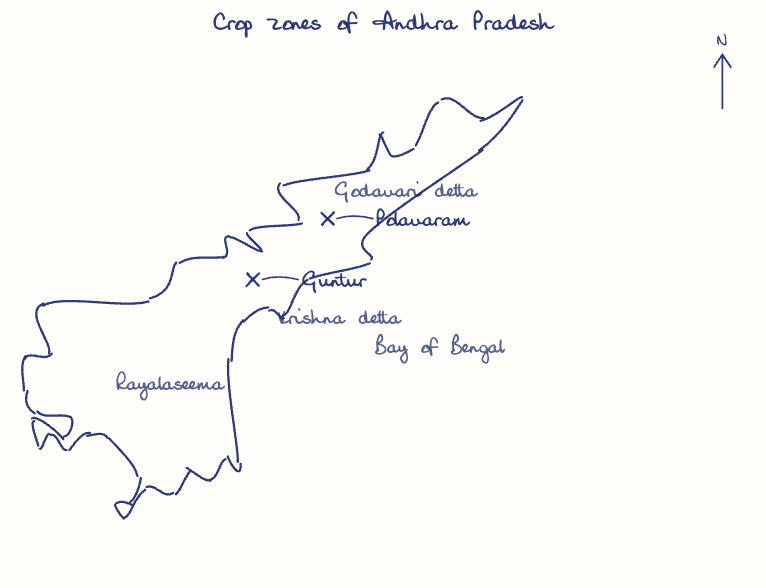
Crop suitability rests on agro-climatic conditions, soil properties, water availability and market viability, while a cropping pattern must justify efficient land use, risk spreading, farmers' food and income needs, and backing from irrigation, storage and technology. Matching crops to each zone, from Rayalaseema to the Krishna-Godavari deltas, keeps farming sustainable.
Model answer
Ghissu Editorial · Verified 4 Oct 2026 · 265 words
Agro-Climatic and Soil Conditions
Soil texture, rainfall, and irrigation govern crop choice; Rayalaseema’s drought-prone region favors millets, while Andhra Pradesh’s coastal and deltaic zones support paddy due to irrigation and soil fertility. Soil salinity and water-holding capacity also influence crop viability.
Water Availability and Management
Water scarcity limits crop options; the Polavaram irrigation project in Andhra Pradesh, once complete, will enable shifts to water-intensive crops like rice. Efficient water management and rainfed compatibility are crucial for sustainability.
Maximizing Efficiency and Risk Mitigation
Cropping patterns like multiple cropping and diversification reduce risks and optimize land use; Andhra Pradesh’s horticulture integration and Rayalaseema’s millet cultivation exemplify this. Crop rotation also helps maintain soil health and productivity.
Socio-Economic and Technological Support
Farmers balance food and income needs; schemes like M-KISAN and Soil Health Card provide technological and infrastructural support for suitable cropping sequences. Access to improved seeds and storage facilities further justifies cropping choices.
Policy and Institutional Frameworks
Government initiatives like PMKSY irrigation projects expand irrigated areas, enabling diversification. Extension services and subsidies further support adoption of suitable cropping patterns.
This model answer is indicative and the model can make mistakes; please verify key facts independently.
Sources
Practise this question
1Get the answer sheet
Sized for this question.
2Write your answer
Timed, by hand.
3Get it marked
Your score and what to fix.
This chapter in the exam
Development vs Environment: natural resources, climate change, EIA, natural disasters48 questions
Asked in 8 of 8 sittings since 2008
Most tested: Climate change and mining/environmental degradation links
- 2025Explain the different types of natural resources in India. How are they being conserved through government initiatives?
- 2025Investigate the relationship between mining activities and the occurrence of earthquakes. Explain how mining operations can be regulated to minimize seismic risks.
All 48 questions, sorted by sub-topic, with model answers and practice.
Question from the official APPSC Group-I Mains 2016 paper. Answer written by Ghissu's engine and checked against our editorial standards. Found an error? Tell us and we correct it within 48 hours.