Distinguish between a Hazard and a Disaster? Narrate various types of natural disasters, the coastal seashore areas are prone to?
In short
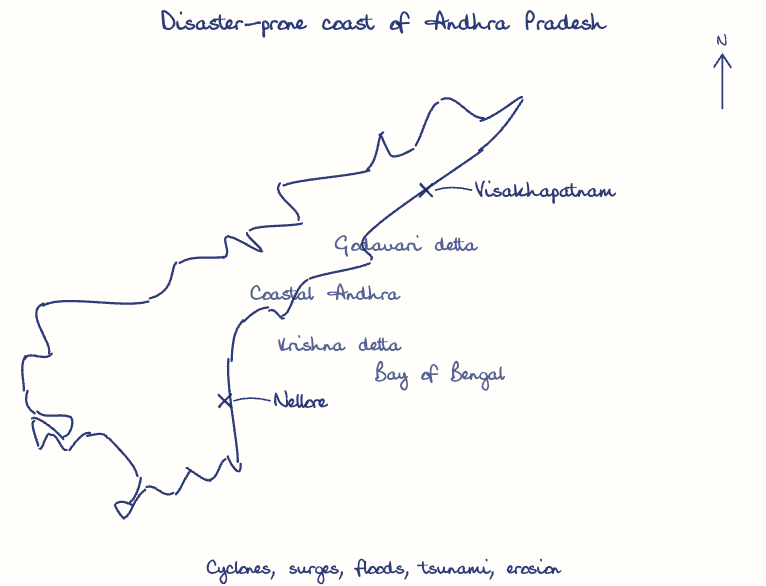
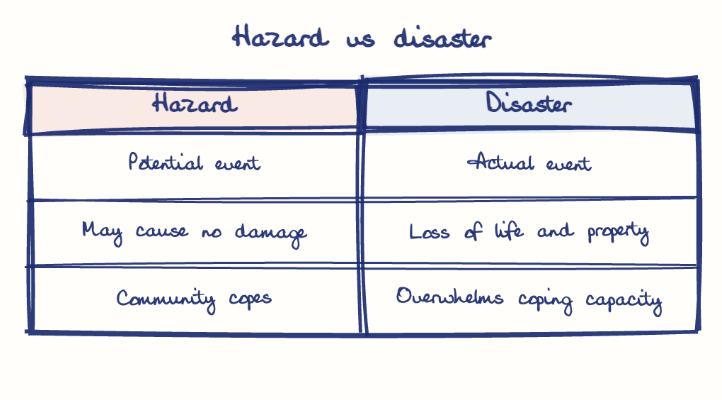
A hazard is a potential threat such as a cyclone, while a disaster is that threat striking a vulnerable community that cannot cope without outside help. Coasts like Andhra Pradesh's 974 km shoreline are prone to cyclones and storm surges, delta floods, tsunamis, erosion and salinisation.
Model answer
Ghissu Editorial · Verified 4 Oct 2026 · 335 words
Hazard and Disaster Defined
A hazard is a potential event like a cyclone; a disaster occurs when it causes severe damage, as in Visakhapatnam’s cyclone impacts.
Vulnerability’s Role
Disaster severity depends on community vulnerability and preparedness, explaining why densely populated coastal cities in Andhra Pradesh are disaster-prone. The Sendai Framework emphasizes reducing vulnerability to prevent hazards from becoming disasters.
Tsunamis and Landslides
The 2004 Indian Ocean tsunami affected Andhra Pradesh’s coast; landslides disrupt hilly coastal regions, as seen in Wayanad where natural and human factors combined1. Coastal Andhra Pradesh lies mostly in seismic zones II and III, with moderate earthquake risk.
Cyclones and Storm Surges
Frequent in Visakhapatnam and Nellore, these threaten fisheries and ports; the World Fish Programme2 supports Odisha’s fisheries sector against such risks.
Flooding and Sea-Level Rise
Low-lying deltas face recurrent floods worsened by climate change, demanding adaptive strategies like CAP-RES (Climate Adaptive Planning for Resilience and Sustainability in Multi-Hazard Environment).
Strategic Knowledge and Planning
The National Mission on Strategic Knowledge for Climate Change (NMSKCC) aids in informed disaster risk reduction by enhancing data and research capacities.
Community Preparedness and Infrastructure
Strengthening early warning systems and resilient infrastructure in coastal zones is vital to mitigate disaster impacts.
This model answer is indicative and the model can make mistakes; please verify key facts independently.
Practise this question
1Get the answer sheet
Sized for this question.
2Write your answer
Timed, by hand.
3Get it marked
Your score and what to fix.
This chapter in the exam
Development vs Environment: natural resources, climate change, EIA, natural disasters48 questions
Asked in 8 of 8 sittings since 2008
Most tested: Climate change and mining/environmental degradation links
- 2025Explain the different types of natural resources in India. How are they being conserved through government initiatives?
- 2025Investigate the relationship between mining activities and the occurrence of earthquakes. Explain how mining operations can be regulated to minimize seismic risks.
All 48 questions, sorted by sub-topic, with model answers and practice.
Question from the official APPSC Group-I Mains 2016 paper. Answer written by Ghissu's engine and checked against our editorial standards. Found an error? Tell us and we correct it within 48 hours.