Explain different patterns of disease outbreak with examples? Differentiate between epidemic and endemic diseases?
In short
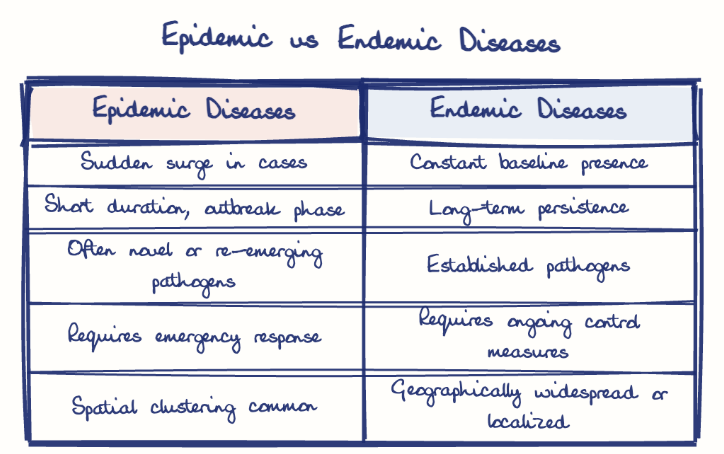
Disease outbreaks follow sporadic, endemic, epidemic and pandemic patterns, spreading from a common source or by propagation. An epidemic is a sudden rise in cases above the expected baseline, like Kerala's 2018 Nipah outbreak, while endemic diseases, like malaria and dengue in Andhra Pradesh, persist at a steady baseline.
Model answer
Ghissu Editorial · Verified 4 Oct 2026 · 322 words
Legal and Administrative Structures
India’s Epidemic Diseases Act, 1897 and Disaster Management Act, 2005 provide outbreak control laws; the 2024 Law Commission report highlights limitations in emerging disease management. Andhra Pradesh coordinates with national bodies to implement these laws locally, adapting to district-level needs.
Surveillance Systems
The Integrated Disease Surveillance Programme (IDSP) and Integrated Health Information Platform (IHIP) enable real-time outbreak monitoring. Post-COVID-19, Andhra Pradesh enhanced these systems for diseases like dengue, improving early detection and response.
Epidemic Diseases
Epidemics involve sudden case surges above baseline, e.g., 2018 Nipah outbreak in Kerala and COVID-19 pandemic, requiring urgent interventions. They typically have a defined start and end with rapid transmission.
Spatial and Temporal Patterns
Epidemics show rapid temporal spikes and clustering, whereas endemic diseases display stable temporal patterns with geographic persistence, such as vector-borne diseases linked to monsoon cycles in coastal and Rayalaseema regions of Andhra Pradesh.
Resource Allocation
Epidemics demand rapid resource mobilization; during COVID-19, Andhra Pradesh struggled to balance resources between epidemic hotspots and endemic control programs.
Data Integration
Challenges remain in integrating private and rural health data despite digital platforms like IHIP. The NITI Aayog Expert Committee recommends improving data sharing and private sector involvement for better outbreak management.
This model answer is indicative and the model can make mistakes; please verify key facts independently.
Practise this question
1Get the answer sheet
Sized for this question.
2Write your answer
Timed, by hand.
3Get it marked
Your score and what to fix.
This chapter in the exam
Human diseases; genetic engineering basics; biotechnology in agriculture; vaccines54 questions
Asked in 8 of 8 sittings since 2008
Most tested: Vaccines and immunisation, alongside GM crops/biotech agriculture.
- 2025Discuss the transmission dynamics of respiratory tract infections in densely populated urban settings. Propose effective public health strategies for their prevention.
- 2025Examine how urban infrastructure influences the implementation of preventive measures during microbial disease outbreaks. Suggest technology-driven solutions.
All 54 questions, sorted by sub-topic, with model answers and practice.
Question from the official APPSC Group-I Mains 2016 paper. Answer written by Ghissu's engine and checked against our editorial standards. Found an error? Tell us and we correct it within 48 hours.