Explain the following: (i) National Bureau of Plant Generic Resources (NBPGR) (ii) Wild-life sanctuaries.
In short
NBPGR is ICAR's premier institute for collecting, conserving and exchanging plant genetic resources, housing the National Genebank in New Delhi and handling germplasm quarantine. Wildlife sanctuaries are protected areas notified by state governments under the Wildlife (Protection) Act, 1972, such as Sri Lankamalleswara and Coringa in Andhra Pradesh.
Model answer
Ghissu Editorial · Verified 4 Oct 2026 · 280 words
NBPGR’s Mandate
As an ICAR institute housing the National Genebank, NBPGR collects, conserves and documents plant genetic resources and is the nodal agency for germplasm exchange and quarantine, while access approvals under the Biological Diversity Act, 2002 rest with the National Biodiversity Authority.
Collaboration for Conservation
It works with State Biodiversity Boards and Biodiversity Management Committees2 to promote in situ and ex situ conservation across agro-ecological zones, enabling decentralized protection of region-specific genetic resources.
Legal Setup and Purpose
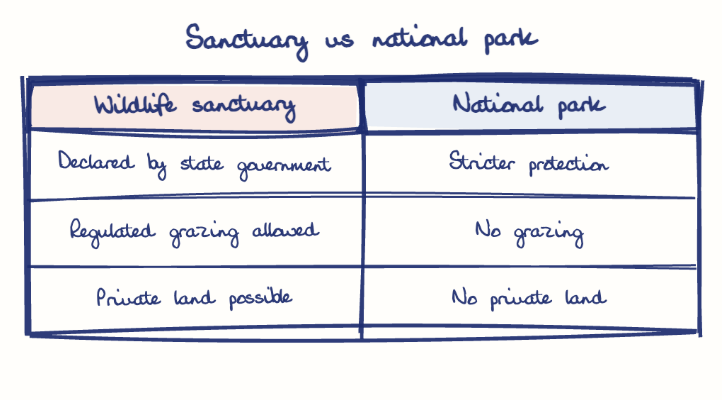
Sanctuaries, notified by states under the Wildlife (Protection) Act, 1972, protect wildlife habitats while permitting limited human use such as regulated grazing, differing from national parks in management flexibility.
Ecological Importance and Challenges
Sanctuaries safeguard rare species, such as Jerdon’s courser in Andhra Pradesh’s Sri Lankamalleswara sanctuary, but face threats from poaching, habitat fragmentation, and human-wildlife conflict, requiring community engagement and integration with projects like Project Tiger3 and Project Elephant for landscape-level conservation.
Conservation Outcomes
Sanctuaries have aided species recovery and habitat preservation; however, NBPGR’s ex situ efforts face gene pool stagnation risks, underscoring the need for dynamic conservation strategies that combine in situ and ex situ approaches.
Future Directions
Strengthening in situ conservation, capacity building, GIS-based monitoring, and public participation are essential for effective biodiversity governance aligned with India’s NBSAP 20244-30, promoting sustainable use and equitable benefit sharing.
This model answer is indicative and the model can make mistakes; please verify key facts independently.
Practise this question
1Get the answer sheet
Sized for this question.
2Write your answer
Timed, by hand.
3Get it marked
Your score and what to fix.
This chapter in the exam
Biotechnology & Nanotechnology: scope, ethics, genetic engineering, biodiversity, fermentation, immuno-diagnosis50 questions
Asked in 8 of 8 sittings since 2008
Most tested: Biodiversity and biotechnology governance/ethics, especially conservation, GMOs, and applied public-health biotech.
- 2025Trace the evolution of India's National Biotechnology Development Strategy (NBDS) and discuss its key objectives. Critically evaluate its impact on the growth of the biotechnology sector in India.
- 2025Analyze the potential of plant-derived biopharmaceuticals in promoting sustainable healthcare. Explain how the application of green pharmacy principles can help minimize environmental harm at each stage of the pharmaceutical lifecycle.
All 50 questions, sorted by sub-topic, with model answers and practice.
Question from the official APPSC Group-I Mains 2016 paper. Answer written by Ghissu's engine and checked against our editorial standards. Found an error? Tell us and we correct it within 48 hours.