(i) What are Lichens? Write their economic importance. (ii) Explain how insects are useful to human beings.
In short
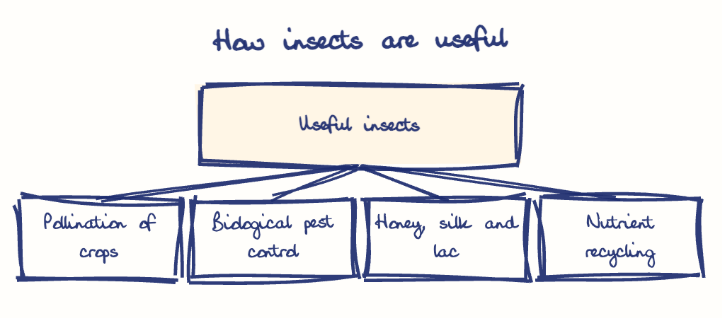
Lichens are composite organisms formed by a fungus and an alga or cyanobacterium, valued for dyes, perfumes, medicines, soil formation and as air-pollution bioindicators. Insects benefit humans by pollinating crops, controlling pests through predators like ladybird beetles, yielding honey, silk and lac, and recycling nutrients.
Model answer
Ghissu Editorial · Verified 4 Oct 2026 · 256 words
Symbiotic Nature
Lichens, a fungus-alga mutualism, colonize harsh habitats, aiding soil formation and nutrient cycling in Eastern Ghats of Andhra Pradesh, which supports forest health and agricultural productivity.
Economic and Environmental Role
Harvested for dyes, perfumes, and traditional medicines, lichens provide income to local communities. They also serve as sensitive bioindicators in Andhra Pradesh's industrial corridors, helping monitor air pollution and guide sustainable development policies.
Pollination and Pest Control
Bees, butterflies, and parasitic wasps boost crop yields and control pests in Rayalaseema and Coastal Andhra, reducing chemical pesticide use and enhancing food security.
Economic Products and Soil Health
Sericulture in Anantapur district supports rural employment and export revenue; detritivorous insects enhance soil fertility and moisture retention in drought-prone Rayalaseema, sustaining agrarian livelihoods.
Threats and Awareness
Pollution and habitat loss threaten lichens and beneficial insects; extension services from institutions like Acharya N.G. Ranga Agricultural University are essential to raise farmer awareness and adoption of biological methods.
Conservation and Research
Community-based conservation programs in forest fringes and focused R&D on lichen biofertilizers and insect pest management tailored to Andhra Pradesh's agro-climatic conditions can sustain these vital resources.
This model answer is indicative and the model can make mistakes; please verify key facts independently.
Practise this question
1Get the answer sheet
Sized for this question.
2Write your answer
Timed, by hand.
3Get it marked
Your score and what to fix.
This chapter in the exam
Biotechnology & Nanotechnology: scope, ethics, genetic engineering, biodiversity, fermentation, immuno-diagnosis50 questions
Asked in 8 of 8 sittings since 2008
Most tested: Biodiversity and biotechnology governance/ethics, especially conservation, GMOs, and applied public-health biotech.
- 2025Trace the evolution of India's National Biotechnology Development Strategy (NBDS) and discuss its key objectives. Critically evaluate its impact on the growth of the biotechnology sector in India.
- 2025Analyze the potential of plant-derived biopharmaceuticals in promoting sustainable healthcare. Explain how the application of green pharmacy principles can help minimize environmental harm at each stage of the pharmaceutical lifecycle.
All 50 questions, sorted by sub-topic, with model answers and practice.
Question from the official APPSC Group-I Mains 2016 paper. Answer written by Ghissu's engine and checked against our editorial standards. Found an error? Tell us and we correct it within 48 hours.