What is meant by mineral resources? How they form? Write about different types of mineral resources.
In short
Mineral resources are naturally occurring, usually inorganic substances of definite composition found in the earth's crust in economically extractable concentrations, formed through igneous, metamorphic, sedimentary and weathering processes. They are metallic (ferrous and non-ferrous) or non-metallic, and Andhra Pradesh holds 86.11% of India's barytes reserves.
Model answer
Ghissu Editorial · Verified 4 Oct 2026 · 296 words
Legal and State Role
The Mines and Minerals (Development and Regulation) Act, 1957 declares minerals a national asset; states like Andhra Pradesh regulate mining leases, holding 86.11% of barytes and 18.49% of road metal reserves.
Exploration and Policy Initiatives
Institutions like the Geological Survey of India and National Mineral Development Corporation lead exploration; the National Critical Mineral Mission32 (2024-31) focuses on securing critical minerals for clean energy, supported by District Mineral Foundation and Mineral Exploration Research and Innovation Trust.
Geological Formation
Minerals form in igneous, metamorphic, and sedimentary rocks through heat, pressure, and chemical reactions; found as veins, beds, or residual deposits.
Classification and Economic Role
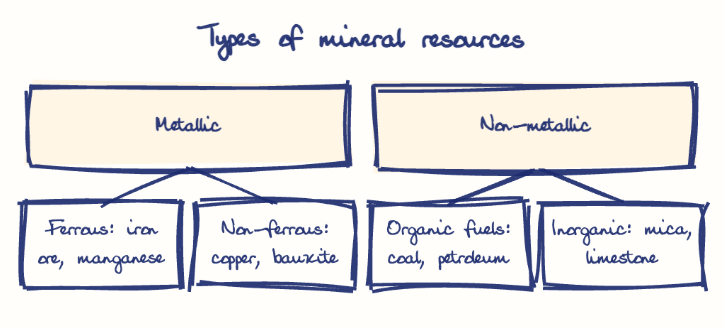
Classified into metallic (ferrous like iron ore, non-ferrous like copper) and non-metallic (organic fuels like coal, inorganic like limestone), minerals support industries from metal production to construction; Andhra Pradesh’s limestone aids local cement production.
Revenue and Compliance
CAG audit (2017-22) flagged revenue shortfalls up to 52%, indicating governance gaps.
Sustainability and Innovation
District Mineral Foundation channels mining revenues to communities; however, underinvestment in Mineral Exploration Research and Innovation Trust limits technological progress.
This model answer is indicative and the model can make mistakes; please verify key facts independently.
Practise this question
1Get the answer sheet
Sized for this question.
2Write your answer
Timed, by hand.
3Get it marked
Your score and what to fix.
This chapter in the exam
Development vs Environment: natural resources, climate change, EIA, natural disasters48 questions
Asked in 8 of 8 sittings since 2008
Most tested: Climate change and mining/environmental degradation links
- 2025Explain the different types of natural resources in India. How are they being conserved through government initiatives?
- 2025Investigate the relationship between mining activities and the occurrence of earthquakes. Explain how mining operations can be regulated to minimize seismic risks.
All 48 questions, sorted by sub-topic, with model answers and practice.
Question from the official APPSC Group-I Mains 2016 paper. Answer written by Ghissu's engine and checked against our editorial standards. Found an error? Tell us and we correct it within 48 hours.