Describe the impact of the Revolt of 1857 on British Rule in India. What were the major changes in the British policies and rule after the revolt ?
In short
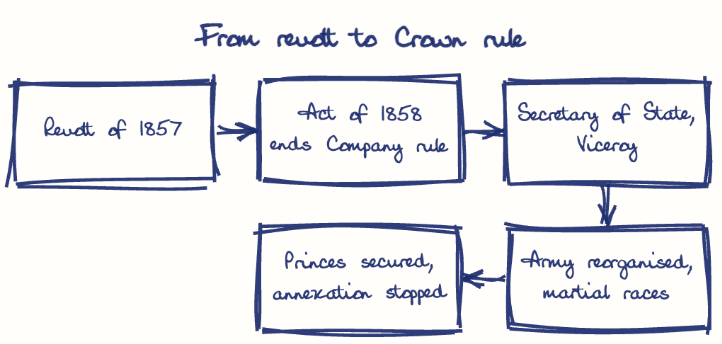
The Revolt of 1857 ended East India Company rule, transferring power to the Crown under the Government of India Act 1858, which created the Secretary of State and Viceroy. Afterwards the British abandoned annexations like the Doctrine of Lapse, reorganised the army, deepened racial distance and pursued divide and rule.
Model answer
Ghissu Editorial · Verified 4 Oct 2026 · 266 words
End of Company Rule
The Government of India Act, 1858 ended Company rule, transferring sovereignty to the Crown; Queen Victoria became Empress in 1877, symbolizing direct imperial control.
Military Reorganization
British increased European troops, recruited “martial races” like Sikhs and Gurkhas, and reorganized regiments to prevent sepoy unity, reducing the risk of future mutinies.
Limited Indian Participation
The Indian Councils Act, 1861 allowed minimal Indian representation, maintaining British dominance and excluding Indians from real power.
Divide and Rule Policy Intensified
The British deepened communal divisions to prevent unified opposition, a strategy that influenced later colonial and post-colonial politics.
Centralization of Power
The Government of India Act, 1858 created the Secretary of State for India and Viceroy posts, centralizing authority and ensuring tighter British control over Indian administration.
Civil Service Reforms
The Indian Civil Service Act, 1861 restructured bureaucracy but maintained British dominance through competitive exams and racial barriers, limiting Indian entry.
Legal Changes
Special courts and laws like the Arms Act suppressed rebellion and consolidated British authority by restricting Indian access to weapons and legal recourse.
This model answer is indicative and the model can make mistakes; please verify key facts independently.
Practise this question
1Get the answer sheet
Sized for this question.
2Write your answer
Timed, by hand.
3Get it marked
Your score and what to fix.
This chapter in the exam
British Rule 1757-1856, the 1857 Revolt, Socio-Religious Reform & the Rise of Nationalism20 questions
Asked in 8 of 8 sittings since 2008
Most tested: Colonialism’s impact on Indian society/economy and reform-led social uplift, especially untouchability and caste reform.
- 2025What do you understand by the Permanent Settlement, and what impact did it have on Indian society? Comment.
- 2025What do you understand by the 'safety valve' theory? Explain it in the context of the Indian National Congress?
All 20 questions, sorted by sub-topic, with model answers and practice.
Question from the official APPSC Group-I Mains 2017 paper. Answer written by Ghissu's engine and checked against our editorial standards. Found an error? Tell us and we correct it within 48 hours.