Discuss the contribution of the Revolutionary Nationalists to the Freedom Movement and their impact on the British Rule.
In short
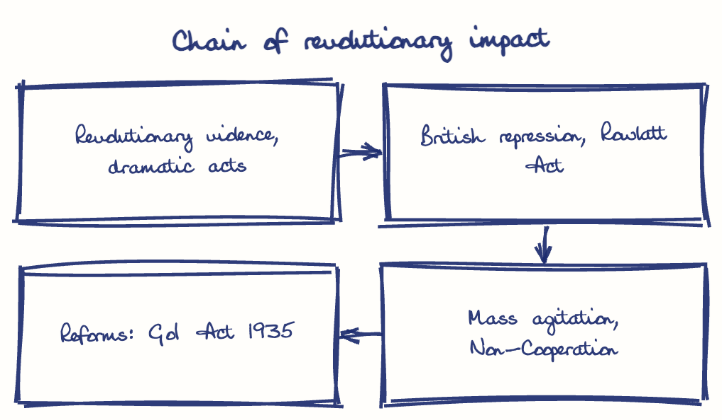
Revolutionary nationalists injected urgency and a socialist vision into the freedom struggle through armed action and propaganda by deed, from the Chapekar brothers (1897) to the Chittagong Armoury Raid (1930). Bhagat Singh's 1929 Assembly bombing typified them, and their activity provoked British repression like the Rowlatt Act.
Model answer
Ghissu Editorial · Verified 4 Oct 2026 · 270 words
Armed struggle and symbolic acts
The Chapekar brothers’ assassination of British officials (1897) and the 1930 Chittagong Armoury Raid exemplify their use of violence to inspire mass mobilization. These acts aimed to awaken political consciousness and demonstrate the vulnerability of British authority.
Socialist ideological shift
Inspired by the 1917 Russian Revolution, HSRA under Bhagat Singh linked political independence with social justice and workers’ rights, broadening nationalist aims. They emphasized equality and anti-imperialism, influencing future leftist movements in India.
Provoking repressive legislation
Revolutionary violence led to the Rowlatt Act (1919), granting extraordinary powers to suppress dissent, which backfired by fueling wider nationalist agitation including Gandhi’s non-cooperation movement. The act alienated moderates and intensified anti-colonial sentiment.
Influencing political reforms
The revolutionary threat pressured the British into reforms like the Government of India Act 19351, aiming to stabilize governance though falling short of full self-rule. These reforms reflected British attempts to placate Indian demands amid growing unrest.
Preserve revolutionary heritage
Developing memorials and heritage projects can honor leaders and educate the public about their sacrifices and ideals.
This model answer is indicative and the model can make mistakes; please verify key facts independently.
Practise this question
1Get the answer sheet
Sized for this question.
2Write your answer
Timed, by hand.
3Get it marked
Your score and what to fix.
This chapter in the exam
Indian Nationalism in Three Phases; Independence, Partition and After22 questions
Asked in 8 of 8 sittings since 2008
Most tested: Gandhian mass movements and their impact, alongside peasant mobilisation and communalism/partition.
- 2025Discuss the role and contributions of the moderate leaders of Congress from 1885 to 1905.
- 2025Describe the major movements led by Mahatma Gandhi between 1920 and 1947.
All 22 questions, sorted by sub-topic, with model answers and practice.
Question from the official APPSC Group-I Mains 2017 paper. Answer written by Ghissu's engine and checked against our editorial standards. Found an error? Tell us and we correct it within 48 hours.