Explain Sufism and discuss its main principles, important orders and their influence on the Indian society.
In short
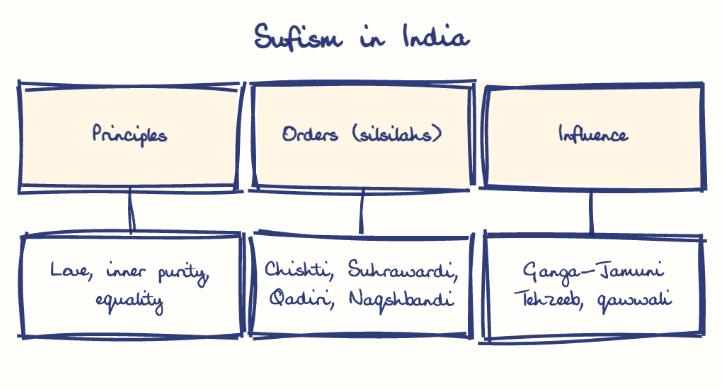
Sufism is the mystical strand of Islam seeking union with God through love, inner purity and the pir-disciple bond, rejecting caste and absorbing Indian practices. Orders like the Chishti, Suhrawardi, Qadiri and Naqshbandi spread it, while saints like Moinuddin Chishti and Nizamuddin Auliya fostered Ganga-Jamuni Tehzeeb, Qawwali and vernacular literature.
Model answer
Ghissu Editorial · Verified 4 Oct 2026 · 261 words
Major Sufi Orders
Indian Sufism comprised about twelve silsilahs, including Chishti, Suhrawardi, Qadiri, Firdawsi, and Naqshbandi, each led by pirs in khanqahs, maintaining spiritual lineage through disciple-pir relationships. These khanqahs functioned as centers of spiritual learning and social welfare.
Orthodoxy vs Mysticism
Divisions between Ba-shara (Sharia followers) and Be-shara (non-bound) allowed Sufism to reach diverse social strata despite orthodox tensions. This flexibility helped Sufi saints like Khwaja Moinuddin Chishti gain mass appeal.
Cultural Contributions
Saints preached in Persian and vernaculars like Punjabi and Awadhi; poets like Amir Khusrau and Bulleh Shah enriched literature; Qawwali music and syncretic dargah architecture fostered cultural integration. These artistic forms became vehicles for spiritual and social messages.
Composite Identity and Social Reform
Sufism blended Islamic mysticism with Indian ideas, challenging caste hierarchies and inspiring social upliftment. It promoted the Ganga-Jamuni Tehzeeb, a symbol of communal harmony.
Educational and Charitable Roles
Khanqahs served as centers for education and charity, promoting literacy and welfare, thus strengthening community bonds and aiding marginalized groups.
This model answer is indicative and the model can make mistakes; please verify key facts independently.
Practise this question
1Get the answer sheet
Sized for this question.
2Write your answer
Timed, by hand.
3Get it marked
Your score and what to fix.
This chapter in the exam
Early Medieval & Medieval India - Pallavas to Cholas, Delhi Sultanate, Bhakti & Sufi, Kakatiya-Vijayanagara-Bahmani-Qutubshahi13 questions
Asked in 8 of 8 sittings since 2008
Most tested: Medieval cultural history through Bhakti/Sufi and South Indian dynastic contributions to religion, architecture, and social organization.
- 2025Describe the contributions of the Chalukya rulers of Kalyani in the fields of sculpture, architecture, and literature.
- 2025Describe the characteristics of the Sufi movement and assess its impact on Indian culture.
All 13 questions, sorted by sub-topic, with model answers and practice.
Question from the official APPSC Group-I Mains 2017 paper. Answer written by Ghissu's engine and checked against our editorial standards. Found an error? Tell us and we correct it within 48 hours.