"Gandhi was a politician among saints and a saint among politicians." Discuss.
In short
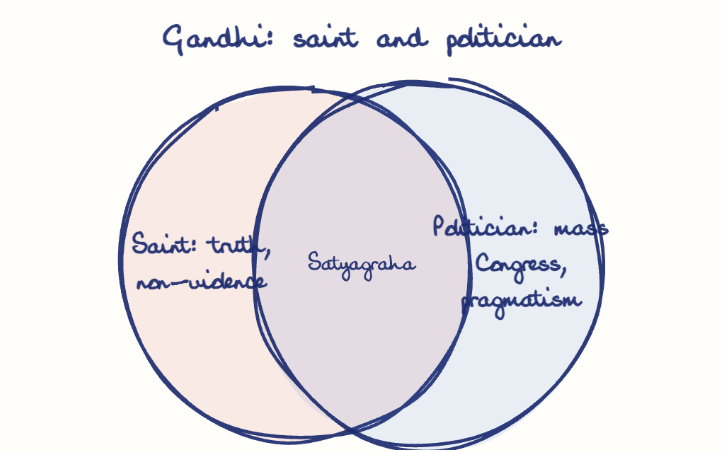
The description fits because Gandhi made truth and non-violence the basis of political action while remaining a shrewd mass mobiliser who turned the Congress into a mass movement. His Satyagraha, Gram Swaraj and trusteeship joined ethics with strategy, though his Harijan campaign showed the limits of moral persuasion.
Model answer
Ghissu Editorial · Verified 4 Oct 2026 · 272 words
Institutional innovation
He transformed the Indian National Congress into a mass movement emphasizing Gram Swaraj and trusteeship, promoting decentralized power and social justice. His vision influenced later reforms like the 73rd Constitutional Amendment institutionalizing Panchayati Raj.
Balancing idealism and pragmatism
Gandhi constantly negotiated between moral ideals and political demands, suspending movements when unprincipled elements threatened their ethical basis. His South African experience taught him the importance of maintaining moral discipline in mass mobilization.
Social reform limitations
His Harijan upliftment faced orthodox resistance and skepticism from Dalits like Ambedkar, revealing the limits of moral persuasion in entrenched caste hierarchies. Despite symbolic campaigns against untouchability, deep social prejudices persisted, highlighting the gap between vision and reality.
Empowering grassroots democracy
Strengthening Panchayati Raj realizes Gandhi’s vision of self-reliant communities and inclusive development.
Addressing social inequalities
Political strategies must go beyond symbolism to dismantle caste and class barriers, ensuring genuine social equality.
Promoting dialogue and reconciliation
Gandhi’s emphasis on dialogue aids communal harmony in pluralistic societies, fostering peace amid diversity.
This model answer is indicative and the model can make mistakes; please verify key facts independently.
Practise this question
1Get the answer sheet
Sized for this question.
2Write your answer
Timed, by hand.
3Get it marked
Your score and what to fix.
This chapter in the exam
Indian Nationalism in Three Phases; Independence, Partition and After22 questions
Asked in 8 of 8 sittings since 2008
Most tested: Gandhian mass movements and their impact, alongside peasant mobilisation and communalism/partition.
- 2025Discuss the role and contributions of the moderate leaders of Congress from 1885 to 1905.
- 2025Describe the major movements led by Mahatma Gandhi between 1920 and 1947.
All 22 questions, sorted by sub-topic, with model answers and practice.
Question from the official APPSC Group-I Mains 2017 paper. Answer written by Ghissu's engine and checked against our editorial standards. Found an error? Tell us and we correct it within 48 hours.