Trace the origin and expansion of the Satavahana power and describe their contribution to religion and literature.
In short
The Satavahanas, a local Deccan dynasty identified with the Andhras, rose after the Mauryan decline from Pratishthana and expanded under Satakarni I and Gautamiputra Satakarni, who crushed Nahapana. They revived Vedic sacrifices yet patronised Buddhism at Amaravati, and Hala's Prakrit Gathasaptasati marks their literary contribution.
Model answer
Ghissu Editorial · Verified 4 Oct 2026 · 265 words
Deccan Tribal Roots and Mauryan Legacy
The Satavahanas, linked to the Andhras, adopted Brahmanical rituals to legitimize rule, with Pratishthana as capital and Satakarni I (c. 50 BCE) consolidating power post-Mauryan fragmentation. Their use of matronymics in inscriptions indicates a blend of local customs with orthodox traditions.
Decline and Fragmentation
Later faced challenges from Abhiras, Traikutakas, and Ikshvakus, fragmenting their territory, with remnants ruling parts of Andhra Pradesh and Karnataka, marking the end of their imperial dominance.
Brahmanical Patronage and Buddhist Support
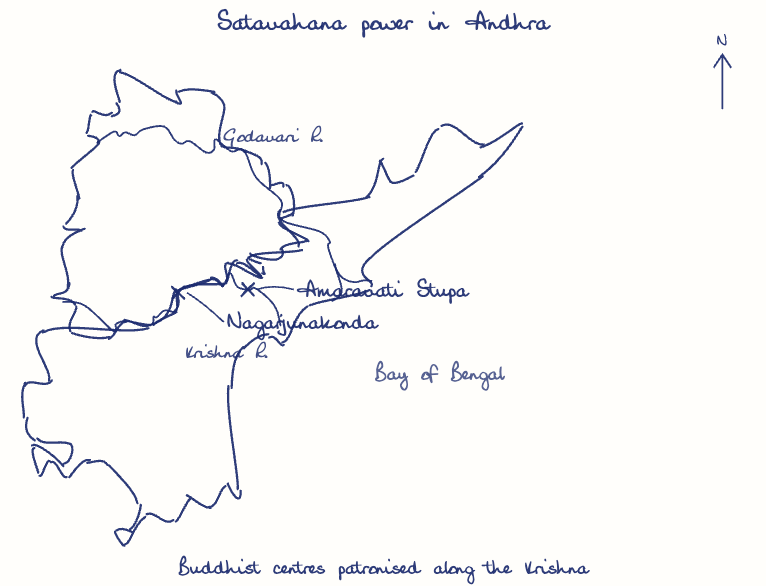
They performed grand Vedic sacrifices such as asvamedha and rajasuya, documented in Nanaghat inscriptions of Queen Naganika, while also supporting Buddhism at Amaravati and other Krishna valley centres, fostering religious synthesis and tolerance.
Buddhist Intellectualism and Limited Jain Influence
Acharya Nagarjuna’s philosophical contributions flourished under royal patronage, highlighting the dynasty’s pluralism; however, Jainism received limited support, reflecting Brahmanism and Buddhism’s predominance.
Prakrit and Sanskrit1 Literature
King Hala’s *Gathasaptasati* exemplifies early Prakrit patronage; later rulers like Kuntala Satakarni promoted Sanskrit, leading to its supremacy in the Deccan, influencing inscriptions and works such as Sarvavarma’s *Katantra Vyakarana*, which simplified Sanskrit grammar.
This model answer is indicative and the model can make mistakes; please verify key facts independently.
Practise this question
1Get the answer sheet
Sized for this question.
2Write your answer
Timed, by hand.
3Get it marked
Your score and what to fix.
This chapter in the exam
Andhra - Ancient16 questions
Asked in 8 of 8 sittings since 2008
Most tested: Satavahana socio-religious and cultural life, especially society, religion, and literature.
- 2025How did far trade routes contribute to the exchange of Buddhist ideas in ancient Andhra?
- 2025What are the various stories about the origins of Andhra people and the Andhra language?
All 16 questions, sorted by sub-topic, with model answers and practice.
Question from the official APPSC Group-I Mains 2017 paper. Answer written by Ghissu's engine and checked against our editorial standards. Found an error? Tell us and we correct it within 48 hours.