Distinguish between Judicial Review and Judicial Activism and also cite the important decisions of the Supreme Court on the two subjects.
In short
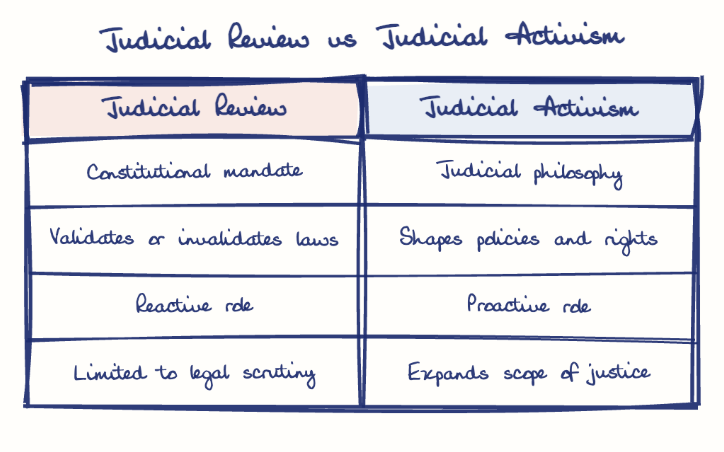
Judicial review is the constitutional power to invalidate laws and actions that violate the Constitution, while judicial activism is the proactive use of interpretation and PILs to expand rights and fill policy gaps. Kesavananda Bharati (1973) and the NJAC case (2015) illustrate review, and Vishaka (1997) and Puttaswamy (2017) activism.
Model answer
Ghissu Editorial · Verified 4 Oct 2026 · 305 words
Judicial Review
Courts examine laws and executive actions for constitutional compliance, invalidating those that violate constitutional provisions, as in Kesavananda Bharati (1973), which established the basic structure doctrine limiting Parliament’s power.
Judicial Activism
Courts proactively shape policies and expand rights, using tools like Public Interest Litigations (PILs) and broad interpretations of fundamental rights, exemplified by Vishaka (1997) which addressed workplace harassment, and Navtej Singh Johar (2018) decriminalizing homosexuality.
Judicial Review’s Role
It protects fundamental rights and federalism, seen in S.R. Bommai (1994) which curtailed misuse of Article 356, and NJAC (2015) where the Supreme Court struck down the National Judicial Appointments Commission to safeguard judicial independence.
Judicial Activism’s Impact
Expanded rights under Article 21, including privacy in K.S. Puttaswamy (2017), addressed social issues through PILs tackling corruption and environmental concerns, and filled policy gaps like in the Singur Land Acquisition case (2016), where land was returned to farmers to protect agrarian interests.
Key Decisions
Kesavananda Bharati (1973), S.R. Bommai (1994), NJAC (2015), K.S. Puttaswamy (2017), and Navtej Singh Johar (2018) illustrate the scope and balance of judicial review and activism in India’s constitutional framework.
This model answer is indicative and the model can make mistakes; please verify key facts independently.
Practise this question
1Get the answer sheet
Sized for this question.
2Write your answer
Timed, by hand.
3Get it marked
Your score and what to fix.
This chapter in the exam
Judiciary in India15 questions
Asked in 8 of 8 sittings since 2008
Most tested: Judicial review and its scope/limits
- 2025What are the emergency functions of the Union Government of India? Describe how they impact the legislative powers of Parliament and State Legislatures.
- 2025Discuss any two constitutional amendments that have significantly affected the powers or functioning of the Indian judiciary.
All 15 questions, sorted by sub-topic, with model answers and practice.
Question from the official APPSC Group-I Mains 2017 paper. Answer written by Ghissu's engine and checked against our editorial standards. Found an error? Tell us and we correct it within 48 hours.