Mention the important events in usage of Electronic Voting Machines (EVMs) in elections in India. Analyse the recent allegations on tampering of EVMs and suggest solutions.
In short
EVMs were first used in Kerala's 1982 Paravur by-election, gained legal backing in 1988 and have been used in all elections since 2004, with VVPATs added from 2013. Tampering allegations remain unproven, and wider VVPAT verification and independent audits can strengthen public trust.
Model answer
Ghissu Editorial · Verified 4 Oct 2026 · 240 words
Phased Adoption and Legal Backing
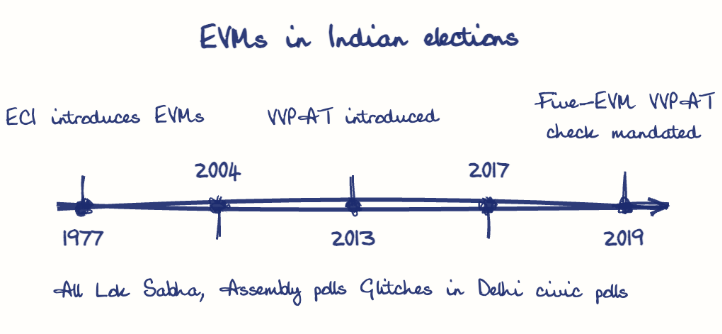
EVMs were introduced in 1977 and fully adopted by 2004, with software developed by BEL and ECIL, secured under the Representation of People’s Act.
VVPAT Integration and Judicial Oversight
VVPAT was introduced in 2013; the Supreme Court mandated random verification of five machines per Assembly segment in 2019 to ensure transparency.
Political Allegations and Technical Failures
Allegations of pre-set manipulation surfaced after Goa and Punjab elections; technical issues like sensor paralysis in Delhi 2017 and by-elections in Kairana exposed vulnerabilities.
Transparency and Public Trust Issues
Limited VVPAT verification and social media misinformation have eroded voter confidence, complicating the ECI’s mandate.
Enhanced Verification and Totalizers
Increasing VVPAT slip counts and deploying totalizer machines can improve auditability and protect voter anonymity.
Capacity Building and Public Engagement
Training election officials, especially in Andhra Pradesh, and voter education via SVEEP and cVIGIL app can dispel myths.
Independent Audits and Tech Upgrades
Third-party audits and research to improve EVM resilience against heat and humidity are essential.
Legal Measures Against Misinformation
Strengthening laws to penalize false information will protect electoral integrity.
This model answer is indicative and the model can make mistakes; please verify key facts independently.
Practise this question
1Get the answer sheet
Sized for this question.
2Write your answer
Timed, by hand.
3Get it marked
Your score and what to fix.
This chapter in the exam
Local governance (73rd/74th) and Constitutional Authorities13 questions
Asked in 6 of 8 sittings since 2008
Most tested: 73rd Amendment and the Finance Commission’s role in local body devolution/fiscal federalism
- 2025Discuss the significance of the 73rd Constitutional Amendment Act in strengthening grassroots democracy in India.
- 2025The Finance Commission is considered the backbone of fiscal federalism in India. Examine its role and significance in maintaining the financial balance between the Union and the States.
All 13 questions, sorted by sub-topic, with model answers and practice.
Question from the official APPSC Group-I Mains 2017 paper. Answer written by Ghissu's engine and checked against our editorial standards. Found an error? Tell us and we correct it within 48 hours.