What are the functions of the National Commission for Women ?
In short
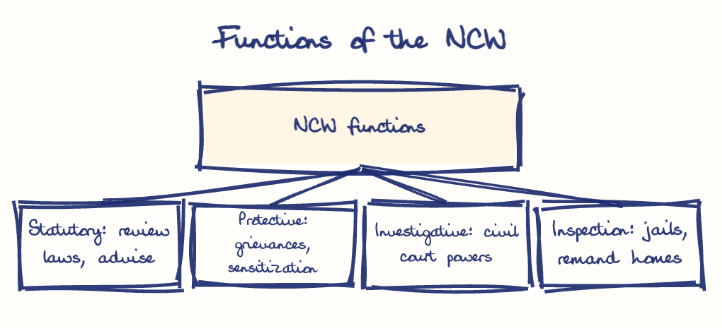
The NCW, set up in 1992 under the National Commission for Women Act, 1990, reviews legal safeguards for women, monitors their implementation, advises governments, redresses complaints and takes suo motu cognizance. With civil court powers it conducts inquiries and inspects jails, though its recommendations lack enforcement authority.
Model answer
Ghissu Editorial · Verified 4 Oct 2026 · 273 words
Legal Safeguard Review
NCW reviews laws affecting women and recommends amendments to ensure relevance and effectiveness, keeping pace with evolving gender issues.
Grievance Redressal and Support
NCW receives complaints, takes suo moto cognizance, and provides legal aid, exemplified by support for victims under schemes like Sambal and Samarthya. It intervenes even in cases lacking direct legal violations to protect women’s dignity.
Quasi-Judicial Powers
NCW can summon witnesses, require documents, and inspect institutions such as jails and remand homes to investigate violations and ensure women’s rights are upheld.
Policy Recommendations
Based on inquiries, it advises governments on reforms and better implementation of safeguards, influencing legislation and administrative action.
Constitutional Status
Granting constitutional status would strengthen NCW’s autonomy and enforcement powers, enabling decisive action to protect women’s rights.
State Coordination
Enhanced collaboration with state bodies, especially in Andhra Pradesh, can improve grassroots impact by supporting schemes like Mission Shakti and ensuring effective local implementation.
This model answer is indicative and the model can make mistakes; please verify key facts independently.
Practise this question
1Get the answer sheet
Sized for this question.
2Write your answer
Timed, by hand.
3Get it marked
Your score and what to fix.
This chapter in the exam
Statutory, regulatory, quasi-judicial bodies and Civil Services9 questions
Asked in 6 of 8 sittings since 2008
Most tested: National Commission for Women and quasi-judicial bodies/Administrative Tribunals.
- 2025Under which Act was the National Commission for Women (NCW) established? Describe its main features and limitations.
- 2025Which constitutional provisions empower the formation of quasi-judicial authorities in India? Explain with suitable examples.
All 9 questions, sorted by sub-topic, with model answers and practice.
Question from the official APPSC Group-I Mains 2017 paper. Answer written by Ghissu's engine and checked against our editorial standards. Found an error? Tell us and we correct it within 48 hours.