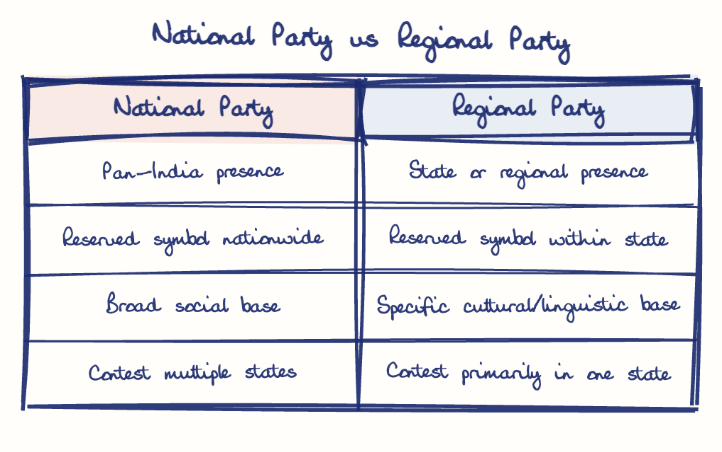
What is the difference between a National party and a Regional party, in case of parties recognised by the Election Commission of India ? Explain the features of the Indian party system.
In short
The Election Commission recognises a National party for winning at least 6% of votes in four or more states plus four Lok Sabha seats, while a Regional party's recognition is confined to one state. India's party system is multi-party, coalition-based and shaped by regional aspirations.
Model answer
Ghissu Editorial · Verified 4 Oct 2026 · 339 words
Recognition by ECI
National parties must secure 6% votes in four or more states plus four Lok Sabha seats or 2% seats from three states; Regional parties require 6% votes and two assembly seats in one state. Since a 2016 amendment, recognition is reviewed after two consecutive elections, still based on performance to ensure broad-based electoral support.
Symbol and Legislative Presence
National parties have reserved symbols nationwide and pan-India legislative presence; Regional parties’ symbols and influence are confined to their states, limiting their electoral branding and legislative reach.
Coalition and Regional Influence
Regional parties articulate local identities and influence Centre-State relations, exemplified by the Telugu Desam Party's exit from the NDA in 2018 and return in 2024, highlighting the impact of regional aspirations on national politics.
Funding and Transparency
Analysis of 31 parties shows electoral bonds account for 55.9% of funding, with Rs.3,438 crore raised in 2019-20, before the Supreme Court struck down the scheme in 2024, raising concerns about transparency and accountability in party financing, affecting both National and Regional parties.
Strengthen Internal Democracy
Political parties must institutionalise transparent leadership selection and candidate nomination to reduce factionalism and enhance accountability.
Enhance Funding Transparency
Reforming party funding mechanisms is essential to curb opaque electoral financing and ensure fair competition.
This model answer is indicative and the model can make mistakes; please verify key facts independently.
Practise this question
1Get the answer sheet
Sized for this question.
2Write your answer
Timed, by hand.
3Get it marked
Your score and what to fix.
This chapter in the exam
Local governance (73rd/74th) and Constitutional Authorities13 questions
Asked in 6 of 8 sittings since 2008
Most tested: 73rd Amendment and the Finance Commission’s role in local body devolution/fiscal federalism
- 2025Discuss the significance of the 73rd Constitutional Amendment Act in strengthening grassroots democracy in India.
- 2025The Finance Commission is considered the backbone of fiscal federalism in India. Examine its role and significance in maintaining the financial balance between the Union and the States.
All 13 questions, sorted by sub-topic, with model answers and practice.
Question from the official APPSC Group-I Mains 2017 paper. Answer written by Ghissu's engine and checked against our editorial standards. Found an error? Tell us and we correct it within 48 hours.