Critically analyse the causes and consequences of India's public debt relating to the period from 1991 till date.
In short
Since 1991, persistent fiscal deficits, expanding Centrally Sponsored Schemes, state reliance on market borrowing and external commercial borrowing have raised India's public debt. Interest has become the Centre's largest revenue expense and Andhra Pradesh's liabilities hit 43.99% of GSDP in 2022-23, though well-used debt can aid growth.
Model answer
Ghissu Editorial · Verified 4 Oct 2026 · 296 words
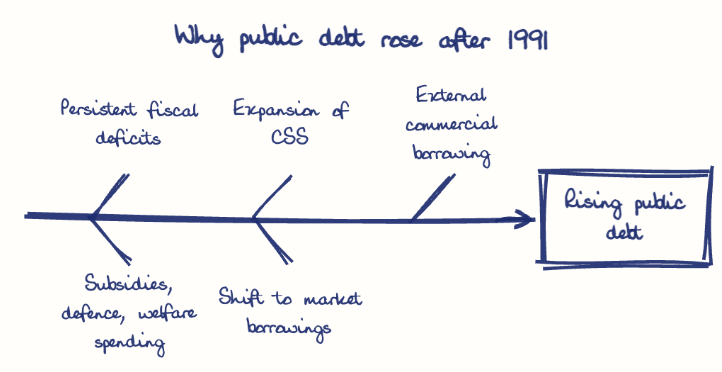
Persistent fiscal deficits
Government spending on subsidies, defence, and welfare outpaced revenues; Andhra Pradesh’s revenue deficit quadrupled, necessitating borrowing.
Expansion of Centrally Sponsored Schemes4 (CSS)
CSS increased states’ expenditure burdens without adequate revenue transfers, pushing states like Andhra Pradesh to borrow more.
Shift to market borrowings
States’ reliance on market borrowings rose from 21.1% to 53.3%, reducing central loans but increasing debt servicing costs.
External debt and exchange risks
Liberalisation led to 11.2% annual growth in external debt (1990-2011), partly due to rupee depreciation.
Rising interest burden
Interest payments rose sharply, crowding out productive expenditure; Centre’s interest payments surged, limiting fiscal space.
Andhra Pradesh’s fiscal health
Outstanding5 liabilities reached ₹5,79,621 crore (43.99% GSDP) in 2022-23, with off-budget borrowings at ₹1,28,048 crore and capital expenditure at 0.55% GSDP, constraining growth.
Growth-debt dynamics
High growth of about 8% with FRBM consolidation (2003-09) reduced debt-to-GDP from 83% to 70%, but unsustainable debt risks crises.
RBI’s dual role challenges
RBI’s debt management and monetary policy roles create conflicts affecting bond markets and fiscal management.
Strengthen fiscal responsibility
Implement Fiscal Responsibility Laws and use Debt Consolidation and Relief Facility (DCRF) to improve sustainability, especially in Andhra Pradesh.
Enhance revenue mobilisation
Improve tax compliance and address ₹2,772 crore outstanding revenue audit observations to reduce deficits.
This model answer is indicative and the model can make mistakes; please verify key facts independently.
Practise this question
1Get the answer sheet
Sized for this question.
2Write your answer
Timed, by hand.
3Get it marked
Your score and what to fix.
This chapter in the exam
Resource Mobilization in Indian Economy19 questions
Asked in 7 of 8 sittings since 2008
Most tested: Public debt and its sustainability in post-reform India.
- 2025Differentiate between internal and external public debt. Explain their relative advantages and risks for a developing country like India.
- 2025Discuss the key instruments of Monetary Policy (RBI) and Fiscal Policy in India and evaluate their role in resource mobilisation and inflation management.
All 19 questions, sorted by sub-topic, with model answers and practice.
Question from the official APPSC Group-I Mains 2017 paper. Answer written by Ghissu's engine and checked against our editorial standards. Found an error? Tell us and we correct it within 48 hours.