Critically examine how illegal mining of river sand in various parts of India is affecting the ecology of rivers and lives of people in the vicinity of these rivers.
In short
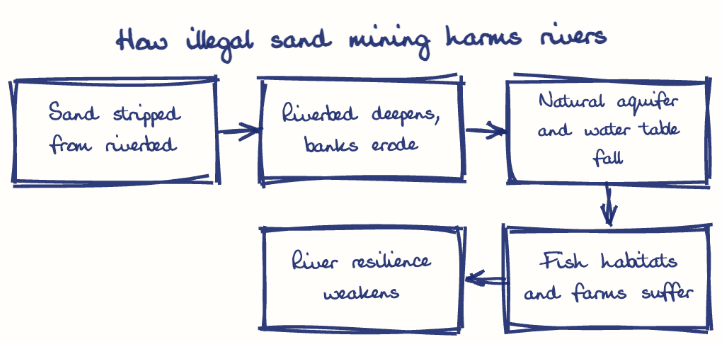
Illegal river sand mining deepens riverbeds, lowers water tables, destroys fish habitats and erodes banks, hurting farmers, fishermen and manual workers while draining state revenue. Weak enforcement of the MMDR Act and the Sustainable Sand Mining Management Guidelines, 2016 lets it persist, including along the Krishna and Godavari.
Model answer
Ghissu Editorial · Verified 4 Oct 2026 · 240 words
Riverbed and groundwater depletion
Illegal mining removes sand that supports aquatic habitats and groundwater recharge, causing riverbed deepening and water table decline, as documented in the Papagni catchment and Gwalior-Chambal floods.
Biodiversity loss and erosion
Sand removal destroys micro-organisms essential for soil fertility and accelerates riverbank and coastal erosion, threatening mangroves and fisheries.
Agricultural and fisheries decline
Water scarcity reduces crop yields in Andhra Pradesh, while fish habitat destruction harms fishermen’s income.
Health and economic costs
Manual miners face severe health hazards; audits reveal royalty and revenue losses in Andhra Pradesh.
Governance and regulatory gaps
Weak enforcement of laws like MMDR Act and Mining Policy 20172, plus delays highlighted in audits and NGT orders (2019, 2021), exacerbate damage.
Damage to infrastructure
Deepened riverbeds undermine bridges, check dams and drinking water intakes, raising public costs.
Enhanced monitoring
Adoption of Mine Mitra portal and Integrated Mining Surveillance System (iMSS) in Andhra Pradesh can curb illegal mining.
Community engagement
Empowering local communities and strengthening District Mineral Foundation Trusts (DMFT) can promote sustainable mining.
This model answer is indicative and the model can make mistakes; please verify key facts independently.
Practise this question
1Get the answer sheet
Sized for this question.
2Write your answer
Timed, by hand.
3Get it marked
Your score and what to fix.
This chapter in the exam
Development vs Environment: natural resources, climate change, EIA, natural disasters48 questions
Asked in 8 of 8 sittings since 2008
Most tested: Climate change and mining/environmental degradation links
- 2025Explain the different types of natural resources in India. How are they being conserved through government initiatives?
- 2025Investigate the relationship between mining activities and the occurrence of earthquakes. Explain how mining operations can be regulated to minimize seismic risks.
All 48 questions, sorted by sub-topic, with model answers and practice.
Question from the official APPSC Group-I Mains 2017 paper. Answer written by Ghissu's engine and checked against our editorial standards. Found an error? Tell us and we correct it within 48 hours.