Discuss India's present composition of energy sources and future energy security scenario in the context of growing energy demand.
In short
India's energy mix is dominated by coal and imported oil, though non-fossil sources formed about 45.5 percent of installed power capacity by June 2024. With demand set to rise two to two-and-a-half times by 2047, security depends on renewables, storage, market reform and Krishna-Godavari basin output.
Model answer
Ghissu Editorial · Verified 4 Oct 2026 · 250 words
Fossil Fuel Reliance
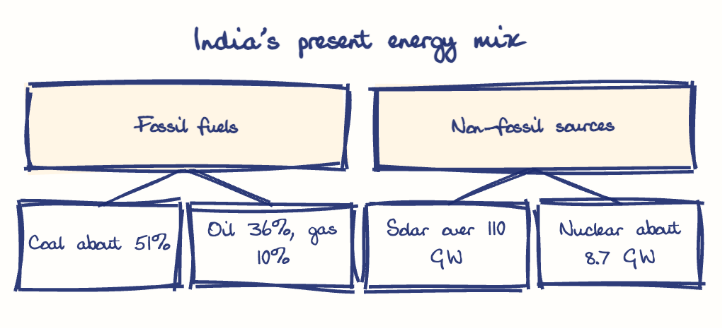
Coal (over half of primary energy), oil and a small share of natural gas dominate consumption, with coal central to power generation.
Renewables Growth
Non-fossil sources, including hydro, nuclear, wind1, and solar, make up 45.5% of installed capacity; solar capacity surged from 2.82 GW (2014) to 110 GW (2025).
Nuclear Capacity Targets
Nuclear power at 1.8% now aims for 22 GW by 2031-32 and 100 GW by 2047, supporting energy security.
Import Dependence and LNG Demand
LNG demand is expected to reach 103 BCM by 2030, exposing India to global price and supply risks.
Infrastructure and Market Reforms
Opening coal mining to private players and competitive power markets are vital for efficiency and investment.
Energy Trilemma Balance
Managing grid flexibility and regional disparities is key to integrating renewables sustainably.
Andhra Pradesh’s Strategic Role2
Andhra Pradesh’s coastline and industrial corridors bolster renewable capacity and energy logistics, enhancing regional security.
Demand Surge Pressures Supply
Doubling energy demand by 2047 requires massive capacity expansion.
Policy and Technology Support
National Action Plan on Climate Change3 and Perform Achieve and Trade scheme promote efficiency and cleaner energy.
State-Level Demand Dynamics
Andhra Pradesh’s agrarian and industrial growth drives energy demand, necessitating grid modernization.
This model answer is indicative and the model can make mistakes; please verify key facts independently.
Practise this question
1Get the answer sheet
Sized for this question.
2Write your answer
Timed, by hand.
3Get it marked
Your score and what to fix.
This chapter in the exam
Energy: needs, resources, policy; Nuclear programme and policy24 questions
Asked in 8 of 8 sittings since 2008
Most tested: Renewable energy transition in India, especially solar/clean energy and barriers to large-scale adoption.
- 2025Differentiate between conventional and non-conventional energy resources. Explain their relevance in India's energy sector.
- 2023What is the current scenario of renewable power generation in India ? Discuss the factors responsible for the growing focus and shift towards Renewable energy.
All 24 questions, sorted by sub-topic, with model answers and practice.
Question from the official APPSC Group-I Mains 2017 paper. Answer written by Ghissu's engine and checked against our editorial standards. Found an error? Tell us and we correct it within 48 hours.