"India's traditional water management methods are key in the present context." Examine the statement with special focus on water harvesting and disaster management.
In short
The statement is valid: traditional systems like eris, tankas, kulhs and johads are decentralised, community-run and ecologically sensitive, recharging groundwater and easing floods and droughts. Combined with GIS and schemes like Atal Bhujal Yojana, as in Andhra Pradesh's tank revival, they strengthen water security and disaster resilience.
Model answer
Ghissu Editorial · Verified 4 Oct 2026 · 261 words
Ecologically Adapted Systems
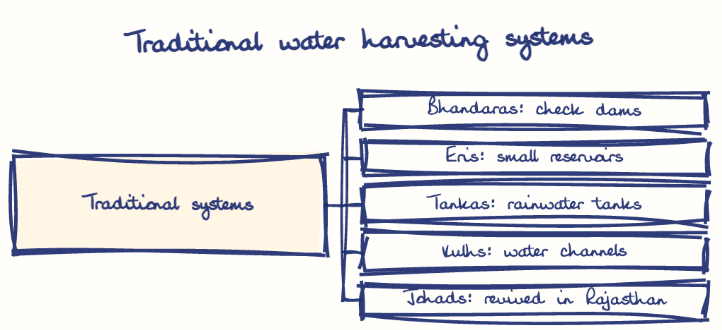
Indigenous methods like bhandaras, eris, tankas, and kulhs are tailored to local conditions and rely on community participation, fostering ownership and sustainability.
Agricultural and Groundwater Support
These systems enhance groundwater recharge and irrigation, crucial in drought-prone areas like Rayalaseema in Andhra Pradesh.
Flood and Drought Mitigation
Traditional structures regulate water flow and reduce runoff, mitigating floods and droughts intensified by climate change.
Case Studies
Restoration of johads in Rajasthan and small reservoirs in Andhra Pradesh have improved local water security and disaster resilience.
Policy and Technology Support
Initiatives like Jal Jeevan Mission and Atal Bhujal Yojana1 promote traditional methods and community groundwater management, with Andhra Pradesh using the Jal Jeevan Mission to strengthen rural water sources.
Challenges and Projects
Institutional fragmentation and funding gaps hinder integration; large projects like the Polavaram Project2 face delays and ecological concerns, underscoring the need for community engagement and technological synergy.
Community Empowerment
Strengthen local participation in Andhra Pradesh for sustainable maintenance of traditional systems.
Technological Optimization
Use GIS and climate models to enhance traditional water harvesting structures.
Policy Alignment
Integrate large infrastructure projects with traditional conservation to balance development and ecology.
This model answer is indicative and the model can make mistakes; please verify key facts independently.
Practise this question
1Get the answer sheet
Sized for this question.
2Write your answer
Timed, by hand.
3Get it marked
Your score and what to fix.
This chapter in the exam
Development vs Environment: natural resources, climate change, EIA, natural disasters48 questions
Asked in 8 of 8 sittings since 2008
Most tested: Climate change and mining/environmental degradation links
- 2025Explain the different types of natural resources in India. How are they being conserved through government initiatives?
- 2025Investigate the relationship between mining activities and the occurrence of earthquakes. Explain how mining operations can be regulated to minimize seismic risks.
All 48 questions, sorted by sub-topic, with model answers and practice.
Question from the official APPSC Group-I Mains 2017 paper. Answer written by Ghissu's engine and checked against our editorial standards. Found an error? Tell us and we correct it within 48 hours.