What is the difference between GSLV and PSLV launch vehicles ? Examine the advantages of GSLV over PSLV.
In short
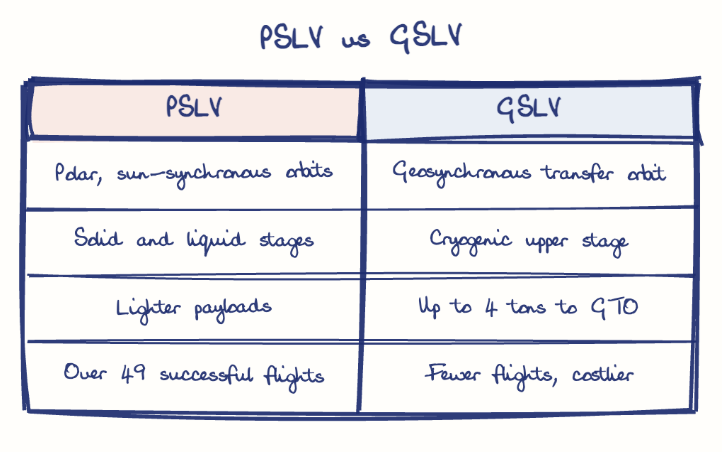
PSLV is designed for polar and sun-synchronous orbits using solid and liquid stages, while GSLV adds a cryogenic upper stage to place heavier communication satellites in geosynchronous transfer orbit. GSLV Mk III lifts about 4 tons to GTO against PSLV's 1.4 tons, giving India heavy-lift autonomy for missions like Chandrayaan-3.
Model answer
Ghissu Editorial · Verified 4 Oct 2026 · 319 words
Distinct Purposes and Payloads
PSLV serves polar and sun-synchronous orbits with about 1.75 tons to SSPO; GSLV Mk III targets geosynchronous transfer orbit with up to 4 tons payload, vital for communication satellites like CMS-031.
Cryogenic Technology Mastery
GSLV’s cryogenic upper stage, indigenously developed and proven since 2014, marks a major institutional achievement, enabling heavier satellite launches beyond PSLV’s scope.
Flight Records and Reliability
PSLV has over 49 successful missions and set a record by launching 104 satellites in one flight; GSLV has built a steadily improving record after mastering cryogenic propulsion, with its LVM3 variant launching Chandrayaan-3.
Launch Frequency and Costs
PSLV benefits from higher launch frequency and cost-effectiveness, attracting international customers; GSLV’s complex cryogenic tech raises costs and limits launch cadence, though it supports heavier payloads.
Higher Payload and Strategic Autonomy
GSLV’s capacity to launch heavier satellites like CMS-03 enhances India’s strategic autonomy by enabling advanced communication and reconnaissance satellites.
Geostationary Orbit Access
GSLV’s design for GTO supports continuous coverage satellites essential for services like weather forecasting and broadband, aiding initiatives such as Digital India in Andhra Pradesh’s rural areas.
This model answer is indicative and the model can make mistakes; please verify key facts independently.
Practise this question
1Get the answer sheet
Sized for this question.
2Write your answer
Timed, by hand.
3Get it marked
Your score and what to fix.
This chapter in the exam
Indian Space Programme, ISRO, Satellites and DRDO23 questions
Asked in 8 of 8 sittings since 2008
Most tested: Remote sensing and satellite applications for agriculture, natural resources, and rural development.
- 2025Describe the role of the Indian Remote Sensing (IRS) satellite programme. How do these satellites assist in natural resource management?
- 2025Discuss the vision and mission of DRDO? Describe the role of DRDO in the contribution to national development.
All 23 questions, sorted by sub-topic, with model answers and practice.
Question from the official APPSC Group-I Mains 2017 paper. Answer written by Ghissu's engine and checked against our editorial standards. Found an error? Tell us and we correct it within 48 hours.