Critically evaluate the central administration under Akbar.
In short
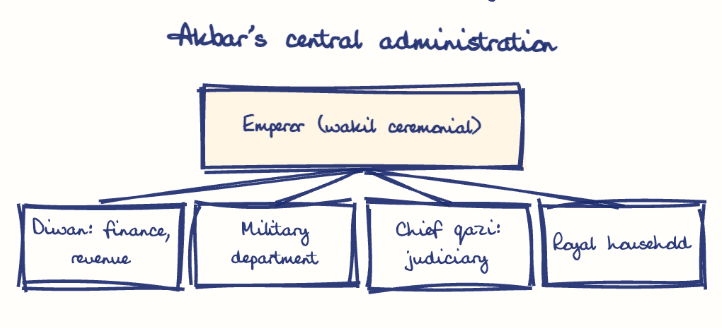
Akbar's central administration was efficient and innovative, dividing power among finance, military, judiciary and household departments, introducing the dahsala revenue system and institutionalising the mansabdari hierarchy. Critically, it also intensified revenue extraction from peasants, suffered corruption in posts like the chief qazi, and reduced local autonomy.
Model answer
Ghissu Editorial · Verified 4 Oct 2026 · 268 words
Division of Authority
Akbar replaced the wazir system with four departments (finance, military, judiciary, royal household), creating checks and balances and preventing power concentration.
Revenue Administration
The dahsala system fixed land revenue based on a ten-year average of crop yields and prices, stabilizing state income and reducing arbitrary assessments.
Mansabdari System
Institutionalized a graded military and bureaucratic hierarchy linking rank, salary, and jagir, professionalizing nobility and ensuring loyalty.
Intelligence and Records
The mir bakhshi managed intelligence and nobility, while court writers recorded imperial orders, aiding centralized control.
Economic Exploitation
Raychaudhuri notes peasants paid higher dues due to centralized price fixing and jagir exploitation, prioritizing imperial revenue over rural welfare.
Corruption and Nepotism
Judicial posts like chief qazi suffered corruption; jagir assignments favored nobles over merit, causing inefficiencies.
Limited Local Autonomy
Centralization reduced local officials’ autonomy, alienating regional powers and disrupting socio-political balances.
Fragmented Power
The wakil became ceremonial; the diwan’s role was confined to revenue, causing administrative overlaps.
Anti-Corruption Measures
Strengthen oversight and transparent appointments in judiciary and revenue departments.
Local Governance
Incorporate local elites to balance central control with regional autonomy.
Revenue Policy Revision
Adjust land revenue to reflect local conditions, protecting peasants.
Departmental Integration
Improve coordination among departments to reduce overlaps and improve efficiency.
This model answer is indicative and the model can make mistakes; please verify key facts independently.
Sources
Practise this question
1Get the answer sheet
Sized for this question.
2Write your answer
Timed, by hand.
3Get it marked
Your score and what to fix.
This chapter in the exam
The Mughals, the Marathas & the Advent of Europeans10 questions
Asked in 7 of 8 sittings since 2008
Most tested: Shivaji and the Maratha state formation, especially rise, administration and state character.
- 2025Discuss the establishment of the East India Company and its early operations in India.
- 2025What impact did the activities of Christian missionaries have on Indian society and culture?
All 10 questions, sorted by sub-topic, with model answers and practice.
Question from the official APPSC Group-I Mains 2020 paper. Answer written by Ghissu's engine and checked against our editorial standards. Found an error? Tell us and we correct it within 48 hours.