Critically evaluate the impact of Quit India Movement of 1942.
In short
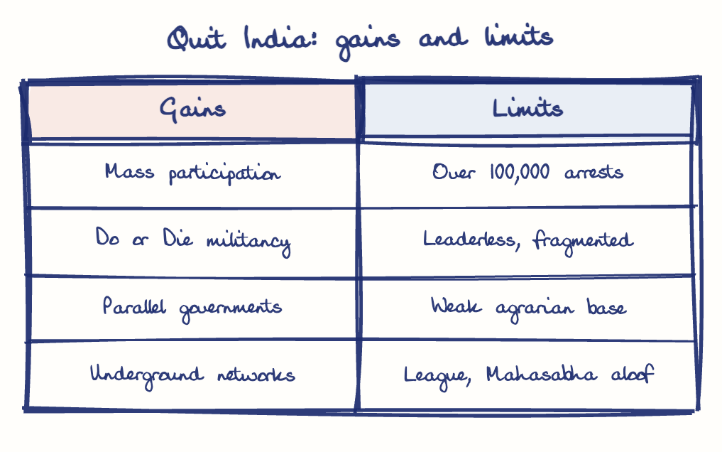
The Quit India Movement of 1942 drew unprecedented mass participation and radicalised the struggle under Gandhi's "Do or Die" call, though over 100,000 arrests left it leaderless and fragmented. Parallel governments at Ballia, Tamluk, Satara and Talcher showed Indian capacity for self-rule and set the stage for post-war independence talks.
Model answer
Ghissu Editorial · Verified 4 Oct 2026 · 300 words
Shift to Assertive Resistance
Gandhi’s “Do or Die” call led to militant tactics challenging British authority more aggressively than before, signaling a shift from earlier strictly non-violent2 campaigns.
Emergence of Parallel Governments
In Ballia, Tamluk (Midnapore), Satara and Talcher, local “people’s governments” took over3 administration, asserting indigenous self-rule and undermining colonial control.
Lack of Centralized Leadership
Arrests left the movement fragmented and uncoordinated, limiting strategic impact and allowing British forces to regain control in many areas.
Uneven Spread
Though peasants joined in large numbers in Bihar, eastern UP and Bengal, the open mass phase was brief and the movement was weaker in many princely states and where the Communists opposed it.
Communal and Political Divisions
Groups like the Muslim League and Hindu Mahasabha opposed or stayed aloof, weakening national unity essential for sustained mass struggle.
Strengthen Inclusive Leadership
Build resilient leadership structures that can withstand repression and maintain coordination across regions and social groups.
Leverage Non-Violent Resistance with Flexibility
Combine Gandhian non-violence4 with adaptive tactics to maintain moral authority while effectively challenging oppression.
This model answer is indicative and the model can make mistakes; please verify key facts independently.
Practise this question
1Get the answer sheet
Sized for this question.
2Write your answer
Timed, by hand.
3Get it marked
Your score and what to fix.
This chapter in the exam
Indian Nationalism in Three Phases; Independence, Partition and After22 questions
Asked in 8 of 8 sittings since 2008
Most tested: Gandhian mass movements and their impact, alongside peasant mobilisation and communalism/partition.
- 2025Discuss the role and contributions of the moderate leaders of Congress from 1885 to 1905.
- 2025Describe the major movements led by Mahatma Gandhi between 1920 and 1947.
All 22 questions, sorted by sub-topic, with model answers and practice.
Question from the official APPSC Group-I Mains 2020 paper. Answer written by Ghissu's engine and checked against our editorial standards. Found an error? Tell us and we correct it within 48 hours.