Delineate the contribution of Dr. B.R. Ambedkar with special reference to the conditions of untouchables and labourers in colonial India?
In short
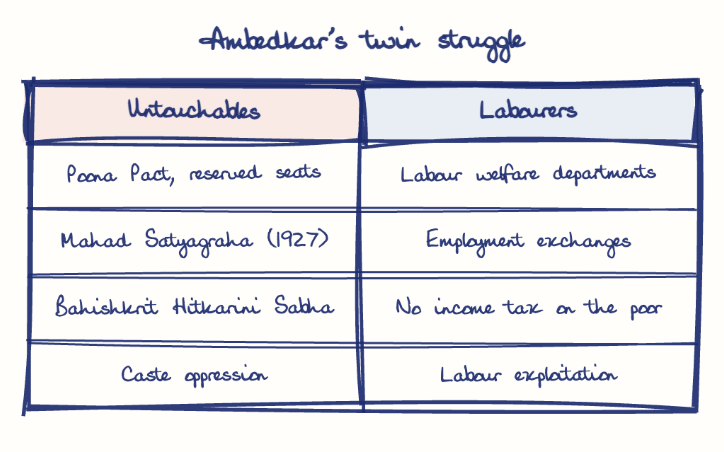
Ambedkar fought for untouchables through political representation, education and mass action like the Mahad Satyagraha (1927), and for labourers by linking caste oppression with economic exploitation. He founded the Independent Labour Party (1936) and, as Labour Member (1942-46), pushed for the eight-hour working day and employment exchanges.
Model answer
Ghissu Editorial · Verified 4 Oct 2026 · 272 words
Dalit Political Representation
Ambedkar’s leadership in the Poona Pact (1932) secured reserved seats for Dalits, marking a historic political inclusion and ensuring their voice in governance.
Dalit Assertion and Identity
Ambedkar led movements like the Mahad Satyagraha (1927) for public water rights, fostering political assertion and self-respect despite violent caste backlash.
Legal Safeguards
His role led to constitutional provisions against untouchability and the 1955 Untouchability Act, beginning to dismantle caste discrimination legally, though social prejudices persisted.
Limitations of Social Integration
Ambedkar critiqued the absorption of Dalit leaders into mainstream parties, which diluted autonomous Dalit movements and limited sustained social transformation during the colonial period.
Labour Rights Advocacy
Through the Independent Labour Party (1936) and as Labour Member of the Viceroy’s Executive Council, Ambedkar pushed for the eight-hour day, labour welfare measures and employment exchanges, addressing exploitation in agriculture and industry and institutionalizing labour protections.
Intersection of Caste and Class Exploitation
Ambedkar uniquely highlighted how untouchability compounded labour exploitation, arguing that social emancipation required addressing both caste oppression and economic injustice simultaneously.
This model answer is indicative and the model can make mistakes; please verify key facts independently.
Sources
Practise this question
1Get the answer sheet
Sized for this question.
2Write your answer
Timed, by hand.
3Get it marked
Your score and what to fix.
This chapter in the exam
British Rule 1757-1856, the 1857 Revolt, Socio-Religious Reform & the Rise of Nationalism20 questions
Asked in 8 of 8 sittings since 2008
Most tested: Colonialism’s impact on Indian society/economy and reform-led social uplift, especially untouchability and caste reform.
- 2025What do you understand by the Permanent Settlement, and what impact did it have on Indian society? Comment.
- 2025What do you understand by the 'safety valve' theory? Explain it in the context of the Indian National Congress?
All 20 questions, sorted by sub-topic, with model answers and practice.
Question from the official APPSC Group-I Mains 2020 paper. Answer written by Ghissu's engine and checked against our editorial standards. Found an error? Tell us and we correct it within 48 hours.