Discuss salient features of the Agrarian system under the Satavahanas.
In short
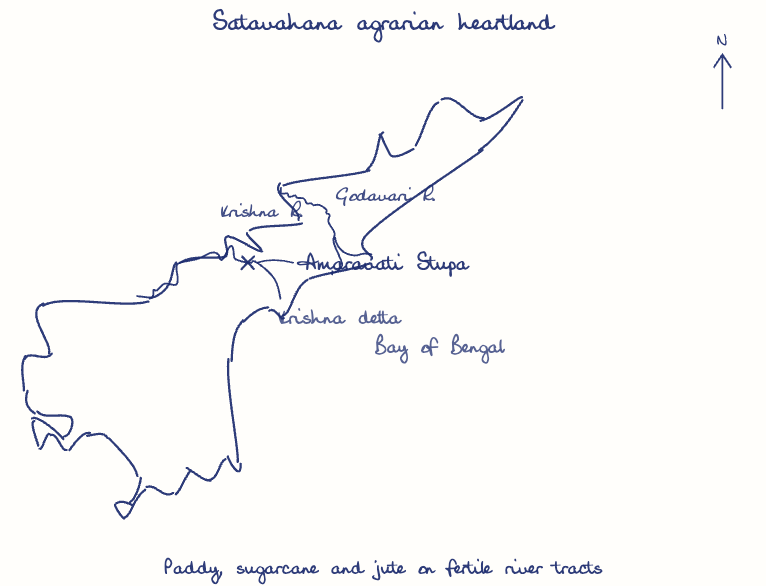
The Satavahana agrarian system rested on the village as the basic unit, tax-free land grants to Brahmanas and Buddhist monks, and feudatory landholders under militarised oversight. Fertile Krishna and Godavari tracts grew paddy, sugarcane and cotton with iron tools, linked to cattle rearing and village industries like jaggery mills.
Model answer
Ghissu Editorial · Verified 4 Oct 2026 · 269 words
Feudal and Military Oversight
Gaulmikas commanded rural regiments to maintain order, showing that agrarian stability was enforced through military presence alongside administration.
Agriculture Backbone
Fertile Krishna and Godavari tracts supported paddy, sugarcane, gingelly and cotton; iron tools and river irrigation enhanced efficiency, reflecting advanced farming techniques.
Village Industry Linkages
Agro-based industries like jaggery mills linked agriculture with local crafts, supporting rural economies and creating interdependent village economies.
Animal Husbandry and Crop Diversity
Cattle rearing for ploughing and transport complemented crop cultivation, indicating a mixed agrarian economy.
Guilds and Merchant Influence
Srenis and Nigamasabhas influenced agrarian trade, especially in Amaravati and Pratishthana, facilitating market access and economic stability.
Religious Patronage and Agrarian Stability
Land grants to religious groups helped enforce social order and respect for political authority, stabilizing agrarian society.
Strengthen Local Governance
Reviving gramika-like institutions can improve rural administration and agricultural productivity in Andhra Pradesh.
Integrate Craft and Agriculture
Supporting agro-based village industries can diversify rural incomes and reduce agrarian distress.
Promote Sustainable Land Grants
Encouraging community-managed land grants with clear rights can stimulate productivity while preserving social harmony.
This model answer is indicative and the model can make mistakes; please verify key facts independently.
Practise this question
1Get the answer sheet
Sized for this question.
2Write your answer
Timed, by hand.
3Get it marked
Your score and what to fix.
This chapter in the exam
Andhra - Ancient16 questions
Asked in 8 of 8 sittings since 2008
Most tested: Satavahana socio-religious and cultural life, especially society, religion, and literature.
- 2025How did far trade routes contribute to the exchange of Buddhist ideas in ancient Andhra?
- 2025What are the various stories about the origins of Andhra people and the Andhra language?
All 16 questions, sorted by sub-topic, with model answers and practice.
Question from the official APPSC Group-I Mains 2020 paper. Answer written by Ghissu's engine and checked against our editorial standards. Found an error? Tell us and we correct it within 48 hours.