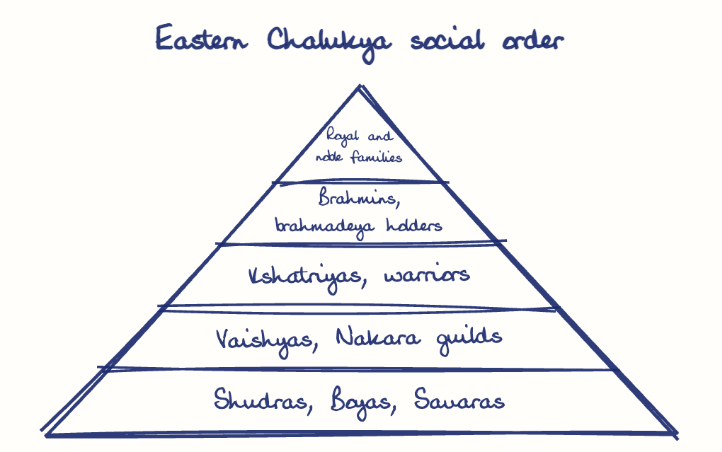
Draw an outline of society under the Eastern Chalukyas.
In short
Society under the Eastern Chalukyas of Vengi was hierarchical and land-based, with Brahmins at the top, Brahmadeya land grants reinforcing caste status, and tribal groups like Boyas and Savaras at the margins. Powerful guilds such as the Nakara, temple-centred life and tolerance of Buddhism and Jainism integrated this society.
Model answer
Ghissu Editorial · Verified 4 Oct 2026 · 252 words
Varna and Feudal Landholding
Brahmins held religious authority and land via Brahmadeyas; Kshatriyas were rulers and warriors; Vaishyas engaged in trade and agriculture; Shudras and tribal groups like Boyas and Savaras formed lower strata linked to menial and forest occupations. Landowning cultivating families were influential, reinforcing caste and administrative power.
Urban Guilds and Nobility
Trade guilds such as Nakara and Telikas signified a thriving mercantile class; royal families maintained status through land grants, military power, and temple patronage.
Caste and Occupation
Each caste had defined roles: Brahmins as priests, Kshatriyas as warriors, Vaishyas as traders, Shudras as artisans and service providers; tribal groups had limited mobility.
Women and Military Service
Royal women influenced temple patronage and property rights; courtesans enriched cultural life; military service offered social mobility through chieftainship.
Religious Pluralism and Temples
Brahmanical Hinduism dominated with Vedic rituals and temple building; Buddhism and Jainism coexisted; temples served as social, economic, and cultural hubs supported by diverse patrons.
Literary and External Influences
Regional languages and Sanskrit1 flourished; maritime links with Southeast Asia enriched art and religious practices.
This model answer is indicative and the model can make mistakes; please verify key facts independently.
Practise this question
1Get the answer sheet
Sized for this question.
2Write your answer
Timed, by hand.
3Get it marked
Your score and what to fix.
This chapter in the exam
Early Medieval & Medieval India - Pallavas to Cholas, Delhi Sultanate, Bhakti & Sufi, Kakatiya-Vijayanagara-Bahmani-Qutubshahi13 questions
Asked in 8 of 8 sittings since 2008
Most tested: Medieval cultural history through Bhakti/Sufi and South Indian dynastic contributions to religion, architecture, and social organization.
- 2025Describe the contributions of the Chalukya rulers of Kalyani in the fields of sculpture, architecture, and literature.
- 2025Describe the characteristics of the Sufi movement and assess its impact on Indian culture.
All 13 questions, sorted by sub-topic, with model answers and practice.
Question from the official APPSC Group-I Mains 2020 paper. Answer written by Ghissu's engine and checked against our editorial standards. Found an error? Tell us and we correct it within 48 hours.