Examine the recommendations of the Cabinet Mission plan.
In short
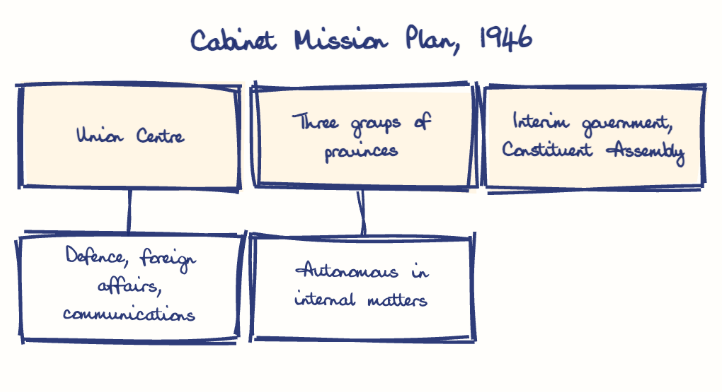
The 1946 Cabinet Mission Plan proposed a united federal India with a Centre limited to defence, foreign affairs and communications, three autonomous groups of provinces, an interim government and an indirectly elected Constituent Assembly. Disputes over compulsory grouping made the League withdraw in July 1946 and call for Direct Action.
Model answer
Ghissu Editorial · Verified 4 Oct 2026 · 296 words
Federal Structure with Three Groups
The plan proposed a united India divided into three groups of provinces (Group A of Hindu-majority provinces, Group B in the northwest and Group C of Bengal and Assam in the east), granting autonomy to these groups while the Centre retained control over defence, foreign affairs, and communications.
Interim Government and Constituent Assembly
It recommended forming an interim government including major parties like Congress and the Muslim League, and an indirectly elected Constituent Assembly tasked with drafting the constitution, initiating a democratic process.
Interim Government Challenges
The League first stayed out of the interim government and joined in October 1946 without accepting the long-term plan, exposing political fragility and mutual distrust between parties.
Breakdown over Grouping
Disputes over compulsory grouping led the League to withdraw its acceptance in July 1946 and boycott the Constituent Assembly, reviving the demand for Pakistan.
Delayed Partition but Deepened Polarization
The plan temporarily halted the demand for Pakistan but intensified Congress-League divides, accelerating partition and communal violence.
Foundation for Federalism
It laid the groundwork for India’s post-independence federal structure, influencing the balance of power between Centre and states, as reflected in the 1950 Constitution.
Inclusive Federalism and Dialogue
Emphasize cooperative governance and institutionalize political dialogue platforms to prevent communal polarization and build consensus on national issues.
This model answer is indicative and the model can make mistakes; please verify key facts independently.
Practise this question
1Get the answer sheet
Sized for this question.
2Write your answer
Timed, by hand.
3Get it marked
Your score and what to fix.
This chapter in the exam
Indian Nationalism in Three Phases; Independence, Partition and After22 questions
Asked in 8 of 8 sittings since 2008
Most tested: Gandhian mass movements and their impact, alongside peasant mobilisation and communalism/partition.
- 2025Discuss the role and contributions of the moderate leaders of Congress from 1885 to 1905.
- 2025Describe the major movements led by Mahatma Gandhi between 1920 and 1947.
All 22 questions, sorted by sub-topic, with model answers and practice.
Question from the official APPSC Group-I Mains 2020 paper. Answer written by Ghissu's engine and checked against our editorial standards. Found an error? Tell us and we correct it within 48 hours.