Vividly examine the impact of Bhakti Movement during medieval India.
In short
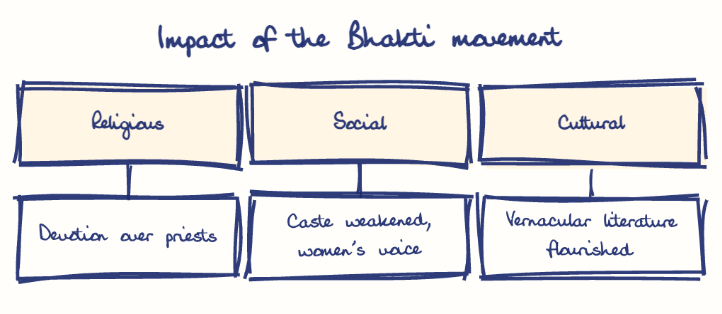
The Bhakti Movement weakened caste hierarchies, empowered women and marginalised groups, enriched vernacular literature and music, and with Sufism fostered Hindu-Muslim harmony. Saints like Kabir, Ravidas, Namadeva, Meera Bai and Andal made devotion accessible to all, and Guru Nanak's teachings laid the ground for Sikhism.
Model answer
Ghissu Editorial · Verified 4 Oct 2026 · 302 words
Political Upheaval and Reform
Decline of Rajput power and temple destruction under the Delhi Sultanate weakened Brahmanical authority, enabling Bhakti and Sufism to promote equality and alternative religious expressions.
Vernacularization and Earlier Traditions
Saints used regional languages, breaking Sanskrit’s monopoly and enabling mass participation. The movement also drew on ideas from the Upanishads, Bhagavad Gita, and Bhagavata Purana, integrating Buddhist, Jain, and Sufi emphasis on personal divine experience and social equality.
Cultural Shift in Music and Community
Emergence of bhajan congregations created communal devotional spaces transcending caste and gender, empowering marginalized groups and fostering vernacular literature like Kabir’s Hindi dohas and Namadeva’s Marathi abhangas.
Inclusive Discipleship and Regional Saints
Ramananda’s acceptance of lower-caste disciples like Ravidas challenged caste norms. Southern saints like Alvars and Nayanars promoted Vaishnavism and Shaivism, while northern saints like Kabir preached social equality.
Women Saints and Literary Contributions
Meera Bai1’s poetry combined pativrat dharma with Bhakti, challenging gender roles. Andal and other women saints also contributed significantly to devotional literature and social critique.
Syncretism and Pluralism
The movement integrated ideas from Buddhism, Jainism, and Sufism, enriching India’s pluralistic religious landscape and promoting communal harmony.
This model answer is indicative and the model can make mistakes; please verify key facts independently.
Sources
Practise this question
1Get the answer sheet
Sized for this question.
2Write your answer
Timed, by hand.
3Get it marked
Your score and what to fix.
This chapter in the exam
Early Medieval & Medieval India - Pallavas to Cholas, Delhi Sultanate, Bhakti & Sufi, Kakatiya-Vijayanagara-Bahmani-Qutubshahi13 questions
Asked in 8 of 8 sittings since 2008
Most tested: Medieval cultural history through Bhakti/Sufi and South Indian dynastic contributions to religion, architecture, and social organization.
- 2025Describe the contributions of the Chalukya rulers of Kalyani in the fields of sculpture, architecture, and literature.
- 2025Describe the characteristics of the Sufi movement and assess its impact on Indian culture.
All 13 questions, sorted by sub-topic, with model answers and practice.
Question from the official APPSC Group-I Mains 2020 paper. Answer written by Ghissu's engine and checked against our editorial standards. Found an error? Tell us and we correct it within 48 hours.