Write a note on art and architecture under the Pallavas.
In short
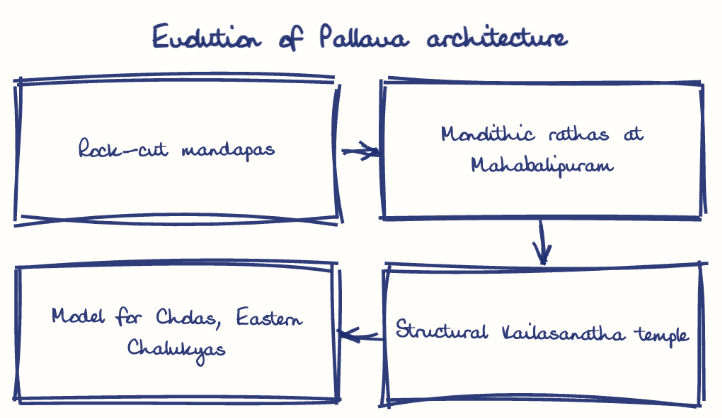
Pallava art and architecture moved temple building from rock-cut mandapas and rathas at Mahabalipuram to structural temples like the Kailasanatha and Vaikunta Perumal at Kanchipuram, setting the template of the Dravidian style. Their tiered vimanas and narrative reliefs such as Arjuna's penance influenced the Eastern Chalukyas, Cholas and Southeast Asia.
Model answer
Ghissu Editorial · Verified 4 Oct 2026 · 265 words
Fresco and Panel Paintings
Mural traces in the Kailasanatha temple at Kanchipuram and at Panamalai reveal skill in mural art with vivid colors and spiritual themes, enriching the period’s visual culture.
Rock-Cut and Structural Temples
Early rock-cut temples like the Rathas transitioned to structural temples such as Kailasanatha and Vaikunta Perumal in Kanchipuram, showing advancements in stone carving and temple design.
Innovative Temple Elements
Introduction of tiered vimanas and early gopurams set architectural precedents for South Indian temples.
Cultural Hegemony
Pallava styles influenced later dynasties including the Eastern Chalukyas in Andhra Pradesh, merging with local traditions.
Maritime Impact
Their motifs spread to Southeast Asia, notably Kambuja (Cambodia) and Champa (Vietnam), demonstrating cultural diplomacy and soft power.
Social Integration
Temples supported the Bhakti movement and Devadasi tradition, preserving classical dance and music forms.
Conservation and Tourism
Collaborate with Andhra Pradesh archaeological bodies to preserve sites and promote heritage circuits linking Pallava and regional monuments.
Research and Documentation
Encourage studies by Andhra Pradesh universities and cultural institutions to deepen understanding of Pallava influences.
Community Engagement
Promote local involvement in heritage preservation to sustain cultural identity and awareness.
This model answer is indicative and the model can make mistakes; please verify key facts independently.
Practise this question
1Get the answer sheet
Sized for this question.
2Write your answer
Timed, by hand.
3Get it marked
Your score and what to fix.
This chapter in the exam
Andhra - Ancient16 questions
Asked in 8 of 8 sittings since 2008
Most tested: Satavahana socio-religious and cultural life, especially society, religion, and literature.
- 2025How did far trade routes contribute to the exchange of Buddhist ideas in ancient Andhra?
- 2025What are the various stories about the origins of Andhra people and the Andhra language?
All 16 questions, sorted by sub-topic, with model answers and practice.
Question from the official APPSC Group-I Mains 2020 paper. Answer written by Ghissu's engine and checked against our editorial standards. Found an error? Tell us and we correct it within 48 hours.