Define judicial activism with special reference to PIL and SAL. Judicial activism has had manifold impact on the political system. Justify the statement adding suitable arguments.
In short
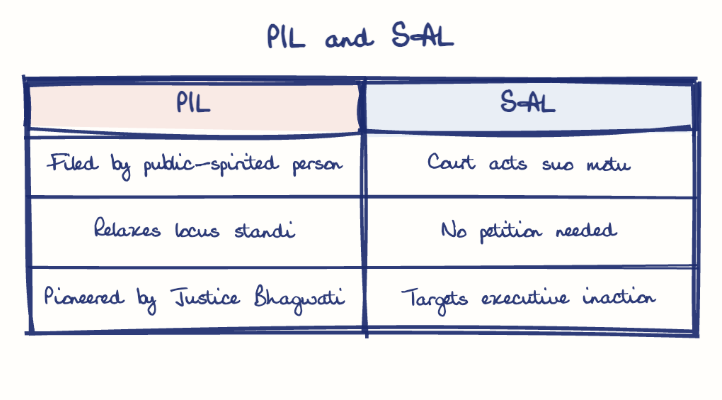
Judicial activism is the courts' proactive role in protecting rights, expressed through PIL, which relaxes locus standi for the disadvantaged, and Social Action Litigation, Upendra Baxi's term for litigation serving the poor. Its impact includes greater accountability, as with candidate disclosure in the ADR case, alongside overreach and case backlogs.
Model answer
Ghissu Editorial · Verified 4 Oct 2026 · 281 words
Public Interest Litigation (PIL)
PIL, pioneered by Justice P.N. Bhagwati, democratized justice access for marginalized groups, exemplified by the Bandhua Mukti Morcha case expanding Article 21 rights.
Social Action Litigation (SAL)
Upendra Baxi's term for Indian PIL aimed at the poor; courts relaxed locus standi, accepted letters as petitions (Sunil Batra) and at times acted suo motu.
Judicial Review and Activism Nexus
Judicial activism extends judicial review by shaping social policy, as in the Maneka Gandhi case broadening personal liberty.
Enhancing Democratic Accountability
Judicial activism enforces transparency, seen in the Association for Democratic Reforms case mandating candidate disclosures.
Expanding Rights and Social Justice
The judiciary protects vulnerable groups and enforces socio-economic rights, including environmental rulings in Andhra Pradesh.
Blurring Separation of Powers
Judicial overreach raises Centre-State tensions, especially in water disputes involving Andhra Pradesh.
Judicial Overburden and Efficiency Issues
Increased PILs strain courts like the Andhra Pradesh High Court, affecting timely justice.
Filling Governance Voids
Judicial activism compensates for executive-legislative inertia, as in Vishaka guidelines on workplace harassment.
Promoting Transformative Constitutionalism
Courts interpret the Constitution as a living document advancing social change.
Safeguarding Marginalized Voices
PILs empower disadvantaged communities, vital for diverse states like Andhra Pradesh.
This model answer is indicative and the model can make mistakes; please verify key facts independently.
Practise this question
1Get the answer sheet
Sized for this question.
2Write your answer
Timed, by hand.
3Get it marked
Your score and what to fix.
This chapter in the exam
Judiciary in India15 questions
Asked in 8 of 8 sittings since 2008
Most tested: Judicial review and its scope/limits
- 2025What are the emergency functions of the Union Government of India? Describe how they impact the legislative powers of Parliament and State Legislatures.
- 2025Discuss any two constitutional amendments that have significantly affected the powers or functioning of the Indian judiciary.
All 15 questions, sorted by sub-topic, with model answers and practice.
Question from the official APPSC Group-I Mains 2020 paper. Answer written by Ghissu's engine and checked against our editorial standards. Found an error? Tell us and we correct it within 48 hours.