Define Judicial Review with special reference to the classification given by Justice Syed Shah Mohamed Quadri. Describe the importance and scope of Judicial Review.
In short
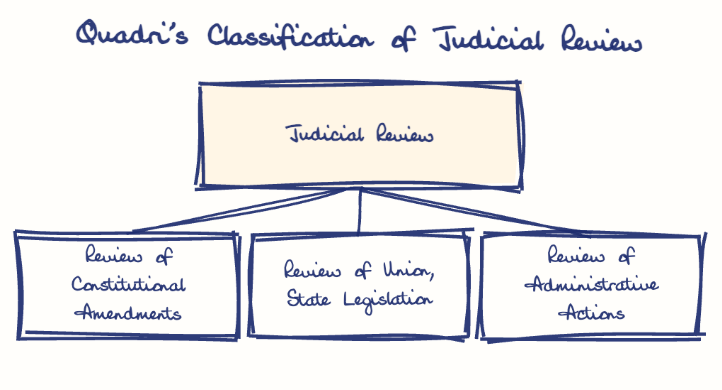
Judicial review is the courts' power to strike down laws and executive actions that violate the Constitution, which Justice Quadri classified into review of constitutional amendments, of legislation and of administrative action. Rooted in Articles 13, 32 and 226, it is a basic feature under Kesavananda Bharati (1973).
Model answer
Ghissu Editorial · Verified 4 Oct 2026 · 290 words
Classification by Justice Syed Shah Mohamed Quadri
Judicial review is categorized into three types: review of constitutional amendments (e.g., the Supreme Court1 struck down the NJAC Act, 2014, reaffirming the basic structure doctrine), review of parliamentary and state legislation (illustrated by cases like Golaknath (1967) and Minerva Mills (1980)), and review of administrative actions by Union and State authorities. This tripartite classification clarifies the comprehensive scope of judicial review across different government branches.
Maintaining Federal Balance and Rule of Law
It adjudicates disputes between the Centre and states, including Andhra Pradesh, preserving federal equilibrium. Judicial review also enforces accountability and transparency, ensuring no authority is above the law.
Legislative and Executive Review
Judicial review covers all laws enacted by Parliament and State Legislatures, including constitutional amendments subject to the basic structure doctrine, as well as administrative decisions and subordinate legislation for legality and constitutionality.
This model answer is indicative and the model can make mistakes; please verify key facts independently.
Practise this question
1Get the answer sheet
Sized for this question.
2Write your answer
Timed, by hand.
3Get it marked
Your score and what to fix.
This chapter in the exam
Judiciary in India15 questions
Asked in 8 of 8 sittings since 2008
Most tested: Judicial review and its scope/limits
- 2025What are the emergency functions of the Union Government of India? Describe how they impact the legislative powers of Parliament and State Legislatures.
- 2025Discuss any two constitutional amendments that have significantly affected the powers or functioning of the Indian judiciary.
All 15 questions, sorted by sub-topic, with model answers and practice.
Question from the official APPSC Group-I Mains 2020 paper. Answer written by Ghissu's engine and checked against our editorial standards. Found an error? Tell us and we correct it within 48 hours.